
Westminster may end 100% Council Tax Support for 9,437 working-age claimants from April 2027, costing band D homes up to £314 a year. Respond by 12 November.
Westminster’s poorest working-age households could have to pay part of their council tax from April 2027. Today they pay none of it.
The council has opened a consultation on ending its 100% Council Tax Support scheme for working-age claimants. It runs until midnight on Thursday 12 November. (Westminster City Council)
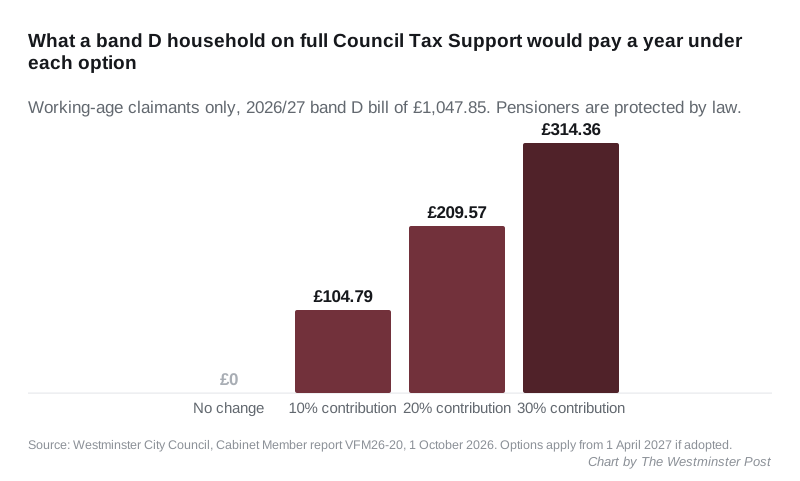
The options are a minimum contribution of 10%, 20% or 30% of the bill. At band D that is between £104.79 and £314.36 a year, or £2.01 to £6.03 a week. Keeping the current scheme is also on the list.
Cllr Paul Fisher, Cabinet Member for Value for Money and Finance, approved the consultation on 1 October. His decision report sets out the numbers. (Cabinet Member report VFM26-20)
Who it affects
Westminster has 15,656 Council Tax Support claims. Pensioners make up 6,219 of them. They are on a national scheme the council cannot change, so they keep 100% support whatever happens.
The other 9,437 claims are from working-age households, and they are the ones in scope. The report breaks that caseload down as follows (a household can fall into more than one group):
| Group | Working-age claims |
|---|---|
| Limited capacity for work | 6,580 |
| Household includes children | 3,935 |
| Lone parent | 1,985 |
| Requires a carer | 665 |
| Disabled child | 569 |
| Claimant aged 18 to 24 | 95 |
Only about 10% of working-age claimants currently get partial support. The rest have their whole bill covered.
The report is blunt on one point. Households affected by any reduction “would have no access to alternative Government-funded support”.
How much it would cost you
The council has published the band D figures. We have worked out bands A to C from the same 2026/27 bills, using the fixed statutory ratios between bands. They assume full support today and no non-dependant deductions.
| Band | Yearly bill | 10% option | 20% option | 30% option |
|---|---|---|---|---|
| A | £698.57 | £69.86 | £139.71 | £209.57 |
| B | £814.99 | £81.50 | £163.00 | £244.50 |
| C | £931.43 | £93.14 | £186.29 | £279.43 |
| D | £1,047.85 | £104.79 | £209.57 | £314.36 |
Band D figures are from the council’s report. Bands A to C are our calculation.
These are based on this year’s bills. If council tax itself goes up sharply in April, as the council has warned it may, the contribution goes up with it.
Why the council is doing this
The council says the government’s Fair Funding Review will cut its grant by £100 million over four years, nearly half. It has been given permission, along with five other councils, to break the usual referendum cap on council tax rises in 2027/28 and 2028/29.
The report says that even doubling council tax next year would leave £80 million of savings still to find. We covered the wider budget gap and the council’s survey in August.
The money from cutting support is small next to that gap. The report puts it at:
- £147,000 a year from a 10% contribution
- £817,000 a year from a 30% contribution
- £483,000 and £1.823 million respectively, if council tax were doubled, which the report says is illustrative only
The whole scheme costs £13.68 million. Working-age support is £8.21 million of that. Westminster pays 51% of the working-age cost and the Greater London Authority pays 49%, which is why the council keeps only part of anything saved.
How Westminster compares
The report calls Westminster “an outlier” among London boroughs. Its own figures show:
- seven London councils still give 100% support
- seventeen give between 71% and 95%
- nine give 70% or less
Among central boroughs, it lists Camden, Tower Hamlets, Wandsworth and the City of London at 100%. Kensington and Chelsea and Hackney give 90%, Islington 95% and Lambeth 73.5%. Bromley, Enfield and Harrow give 50%.
The council says the options would bring it “in line with the average throughout London of 70% - 90%”.
Could some people be protected?
Yes, and the consultation asks about it. An appendix to the report floats a lower contribution, or none, for vulnerable groups.
Disability is the main example. If protecting all 6,580 claims in the limited-capability group is “considered too large a number”, the report suggests a narrower definition. That would cover households on Personal Independence Payment or Disability Living Allowance. It would leave out households whose extra Universal Credit is for a health condition that limits work.
An Equality Impact Assessment will be published with the final proposal.
What it means for you
- If you are of working age and get Council Tax Support, the council says it will post you a questionnaire. You can also respond online now.
- If you are of pension age, your support is set nationally and this change cannot reduce it.
- Anyone can respond, including residents who do not claim. The online survey is on the council’s Council Tax Support consultation site, and it closes at midnight on 12 November.
- Advice agencies, law centres and Citizens Advice are being consulted directly, so they can help if you are unsure how you would be affected.
Our guide to Westminster council tax discounts explains how support is worked out today, including non-dependant deductions. The council tax bands page has every band’s bill.
What happens next
Nothing changes this financial year. After the consultation, Cabinet will make a recommendation and full council takes the final decision.
The report says Full Council is due to consider the 2027/28 council tax base and discounts on 20 January 2027. The legal deadline for changing the scheme is 11 March 2027. Any reduction would need transitional arrangements and would take effect on 1 April 2027.
The council says the scheme is “one of a range of options being considered, including increasing Council Tax and reducing council services.” (Westminster City Council consultation page)
Have your say