
Government cuts leave Westminster a £160m gap, and a Band D bill of £1,048 could rise by £537 a year. What the survey asks, and the 30 September deadline.
Westminster City Council says the government is cutting its funding by almost half over the next four years, leaving it with an estimated £160 million budget gap, and it is asking residents which services they would protect. The survey closes at 5pm on Wednesday 30 September. (Your budget choices)
The council puts the grant cut at £100 million, money it says is being redistributed to other parts of the country. Its core funding falls from £219 million to £119 million. Rising costs, demand and inflation take the gap from £100 million to £160 million. (Westminster City Council, 14 August; Your budget choices survey)
A Westminster Council Tax increase is now explicitly on the table. The government “expects the council to significantly increase Council Tax to make up for the cut in funding, having given the council special permission to do so”, the consultation says, meaning permission to go beyond the usual referendum limit.
Those two funding figures are worth keeping apart. The council’s 100-day announcement, published on 14 August, says it “needs to find £100 million in savings over the next four years”. Its own budget consultation, running at the same time, puts the shortfall at £160 million once costs are added in. The larger number is the one the survey asks residents to help close.
What it could mean for your bill
The council has published the arithmetic, and it is stark. If it changed nothing about its spending, it says Council Tax would need to rise by 200 per cent to fill the gap.
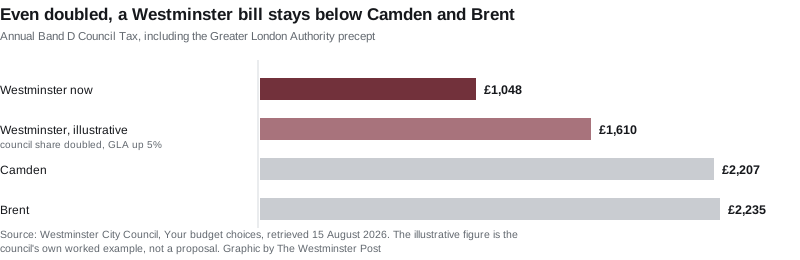
A Band D property in Westminster currently pays £1,048 a year. Of that, £537 goes to the council and £511 to the Mayor of London and the Greater London Authority. The council’s illustration is a doubling of its own share: another £537.34 a year, around £10.33 a week. Add an illustrative 5 per cent GLA rise and the total Band D bill comes to roughly £1,610.
Even then, the council notes, that would sit below neighbouring Camden at £2,207 and Brent at £2,235. Westminster has long had among the lowest Council Tax bills in the country, which is precisely why a cut to its government grant bites harder here: there is less local tax income to absorb it.
The council says many residents on lower incomes do not pay the full amount and some receive support that would protect them from increases.
What the survey actually asks
It takes five to 10 minutes and only completed responses are counted. It asks which services you value most, whether you would pay more Council Tax, and puts you through a “balance the books” exercise using illustrative figures drawn from current service budgets.
The council is explicit about the limits of the exercise: “Your answers help inform decisions, but final budget choices are made by the council.” It also says plainly that “we cannot promise that every service will stay the same”.
A large share of the budget covers services the council is legally required to provide, including protecting vulnerable children, adult social care, temporary accommodation, homelessness services and waste collection. It cannot stop providing those, but it says it can look at spending less on them. Everything else, highways and parking, libraries and leisure centres, parks and open spaces, community safety, is under review.
Paper copies are available on request from budgetchoices@westminster.gov.uk or 020 7641 6000. Residents can also give views in person at five events:
- Friday 28 August, 1pm to 4pm, pre Notting Hill Carnival, Maida Hill Market
- Friday 11 September, from 6pm, St Anne’s Church, Soho (registration required; the council’s page gives an end time of 4pm, which appears to be an error)
- Thursday 17 September, 6pm to 8pm, Westbourne Park Baptist Church, Porchester Road (registration required)
- Friday 18 September, 7pm to 9pm, Jubilee Leisure Centre
- Thursday 24 September, 6pm to 8pm, The Abbey Centre, Victoria (registration required)
Responses feed into budget proposals developed this autumn, with final decisions in spring 2027 for the 2027/28 budget.
The 100 days the money has to pay for
The consultation landed alongside the new administration’s account of its first 100 days in office, built around four priorities: safe streets, clean city, value for money and driving growth. (Westminster City Council, 14 August)
On enforcement, the council says city inspectors have removed more than 500 dockless bikes obstructing pavements and crossings, with fixed penalty notices up 200 per cent since May, a figure we reported when operators agreed a clean-up deal earlier this month. It has created a cabinet member for enforcement post, held by deputy leader Cllr Caroline Sargent.
With the Royal Borough of Kensington and Chelsea, it secured a High Court injunction against car cruising on 30 July. The order runs between 6pm and 6am, applies to gatherings of two or more people in the Hyde Park, St James’s, West End, Knightsbridge and Belgravia wards of Westminster and Brompton and Hans Town in Kensington and Chelsea, and prohibits racing, stunts, excessive revving, amplified music and the promotion or organisation of such events. A power of arrest applies under section 27 of the Police and Justice Act 2006, and the order runs until the first court date after 19 July 2027. (High Court car meets injunction order)
On streets, the council says it has cleared 100 per cent of reported offensive graffiti within 12 hours and 94 per cent of other graffiti within three days, and has served an enforcement notice on Burne House, one of four hotspot sites under investigation.
It has also begun revisiting cycle schemes in Bayswater, Marylebone and St John’s Wood, put existing cycle lanes under review over congestion and safety, and removed floating bus stops from new scheme designs. No detail beyond that has been published; we will report the specifics when a scheme comes forward.
On money, 66 contracts worth more than £5 million each are being reviewed, and the council has become the first local authority in the country with ministerial approval for a data-sharing pilot with HMRC to tackle business rates evasion, aimed at operators including souvenir and candy stores.
What it means for you
If you pay Council Tax in Westminster, no decision has been made and none will be until spring 2027. But the council has said in writing that its funding is being halved and that a 200 per cent rise would be needed to do nothing else, so the 2027/28 bill is the one to watch. The survey is the formal route for saying which services you would protect first.
If you rely on a library, leisure centre or park, these are the discretionary services. The statutory ones, social care, children’s services, homelessness and waste, cannot be dropped, which means proportionally more of any saving has to come from everything else.
If you cannot get to an event, paper copies of the survey are available by phone or email, and the council says it will publish a summary of what it heard before proposals are written.
If you are following what the council is doing with land and buildings, its new Transparency Hub now collects spending, contracts, performance and workforce data in one place. We track applications and decisions on our Westminster planning news page.
Have your say