

Living alone in a band D Westminster home takes £261.96 off the 2026/27 bill. Every discount and exemption, plus the two-year review that removes one.
Westminster has the second lowest council tax in England, so the discounts look small in percentage terms and are worth real money anyway. A single adult in a band D home takes £261.96 off a £1,047.85 annual bill. A household on a low income can have the whole thing written off, because Westminster is one of the councils that never cut its working-age support below 100%.
This page sets out what is available for 2026/27, what each reduction is worth in pounds against the real Westminster charge, and the review that removes the commonest discount if you ignore a letter.
The band charges themselves are on our Westminster council tax bands page, including the two figures the council’s own website prints the wrong way round.
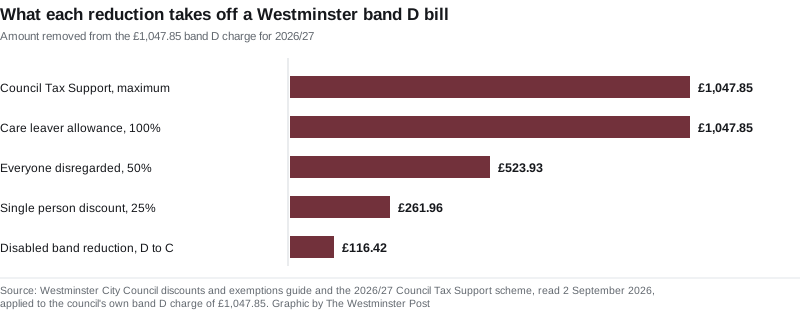
What each reduction is worth on a band D bill
Band D in most of the City is £1,047.85 for the year. These are the amounts taken off that figure.
| Reduction | Who it is for | Taken off a band D bill |
|---|---|---|
| Council Tax Support, maximum award | Low income, any age | £1,047.85 |
| Care leaver allowance | Westminster care leavers | £1,047.85 |
| All occupants disregarded, 50% | For example a household of carers | £523.93 |
| Single person discount, 25% | One adult in the property | £261.96 |
| Disabled band reduction, band D to band C | Adapted home | £116.42 |
Every figure above is 2026/27 and is worked from the council’s own band D charge. The percentages come from the council’s discounts and exemptions guide, updated 18 February 2026.
Single person discount: 25%, and a review every two years
If you are the only adult in the property, you get 25% off. In Westminster that is £261.96 a year at band D, and £174.64 at band A. It applies only to your sole or main residence, which matters here more than in most boroughs.
The trap is the review. The council says the discount stays on the account for as long as you are a single occupier, but that single occupancy is reviewed every two years. If you do not confirm you are still living alone, the discount is removed. That is on the single person discount page, and it is the reason a bill sometimes jumps by a quarter with no change in circumstances.
The people who are not counted
You can still get the 25% discount with more than one adult in the house, if everyone except you is disregarded. If everyone in the household is disregarded, the discount is 50%. If two or more adults are counted, there is no discount at all.
The council disregards:
- full-time students, student nurses, apprentices and youth-training trainees
- 18 and 19 year olds who are at school or have just left
- patients in hospital, and people being looked after in care homes
- people who are severely mentally impaired
- people staying in certain hostels or night shelters
- care workers on low pay, usually working for charities
- carers giving at least 35 hours a week to someone who is not their spouse, partner or child under 18
- members of visiting forces, foreign diplomats and certain international organisations
- members of religious communities, for example monks and nuns
- people in prison, except those jailed for not paying council tax or a fine
Two of these have conditions that are easy to fail. An apprentice counts only if the employer confirms in writing that the training leads to an NVQ or accredited qualification and the salary is less than £195 a week, according to the apprentices discount page. A carer must live in the same home, give at least 35 hours a week, and the person cared for must receive Attendance Allowance, the middle or highest rate care component of DLA, any rate of the PIP daily living component, an increased disablement pension, increased Constant Attendance Allowance or armed forces independence payment. The carers discount page, updated 23 February 2026, adds that no discount applies if two other adults already live there.
Students: a full exemption, not a discount
If everyone living in the property is a full-time student, the property is exempt and there is nothing to pay. If the household is a mix of students and non-students, the reduction is 25%.
Westminster’s student page sets the test for full-time study as a course of at least one academic or calendar year, requiring attendance for at least 24 weeks in the year and at least 21 hours of study a week in term time. Under-20s on a course up to A-level standard qualify on a different test: more than three months, and at least 12 hours a week.
You have to upload a student certificate or written confirmation from the college or university, showing the course, its start and end dates and the required study hours.
Council Tax Support: still 100% in Westminster
Updated 6 October: the council has opened a consultation on asking working-age claimants to pay 10%, 20% or 30% of their bill from 1 April 2027. It closes on 12 November. Our report has the figures for each band. Support stays at 100% for 2026/27.
This is the part worth knowing about, because most councils have quietly cut it. Westminster has not.
The council states plainly that the maximum amount of Council Tax Support payable is 100% of the charge, on its Housing Benefit and Council Tax Support page, last updated 23 March 2026. The 2026/27 scheme document confirms it for working-age claimants as well as pensioners: a Class 1 claimant, meaning someone whose income falls below their applicable amount, is entitled to a 100% reduction, less any non-dependant deductions.
Several London boroughs cap working-age support at 70% or 80%, which leaves the poorest households paying a fifth of the bill. In Westminster a band D household on the maximum award pays nothing.
Three things about the scheme are worth reading before you apply:
- Non-dependant deductions. An adult living with you on a non-commercial basis, typically a grown-up child, reduces the award. For someone working 16 hours a week or more the 2026/27 deduction runs from £5.20 a week on gross income under £279, to £15.95 a week on gross income of £605 or more. It is nil for a non-dependant on Universal Credit with no earned income, on Income Support, on income-based JSA, on income-related ESA, on Pension Credit, in full-time study, or aged under 18.
- Backdating. For pensioners an award can start up to three months before the claim. For working-age claimants it normally starts when you claim, with up to six months’ backdating only if there are special reasons for the delay.
- War pensions are disregarded in full, for pensioners and working-age claimants alike.
If you disagree with a decision, write and ask for a review. The council then has two months to respond, and you can appeal to the Valuation Tribunal within two months of its answer, or within four months of your request if it never replies.
Care leavers pay nothing, and do not have to ask
Westminster grants a 100% council tax hardship allowance under section 13A to care leavers. The council’s discounts guide says there is no need to apply, because the care leaver team notifies the council tax service. At band D that is the full £1,047.85.
Disabled band reduction: one band down, £116.42
If a disabled person lives in the property and the home has an extra bathroom or kitchen, a room mainly used by that person, or enough space to use a wheelchair indoors, the bill is charged at the band below. Band D drops to band C, from £1,047.85 to £931.43, a saving of £116.42.
The scheme page makes two points people miss. Band A properties qualify too, and get a reduction the same in cash terms as bands B, C and D. And the room or wheelchair space must be essential or of major importance to the disabled person’s wellbeing: simply moving a bedroom downstairs is unlikely to qualify. The council sends someone to your home to see the adaptations before deciding.
Where there is no discount at all
Westminster removed the second home discount and went the other way. There is no discount for a furnished property that is not your main residence, and a 100% second home premium has applied since 1 April 2025, so the bill is double. At band D that is £2,095.70 for the year.
Two narrow 50% discounts survive, per the second home page: where you must live elsewhere in job-related accommodation under the terms of your employment, for example a caretaker or a minister of religion, and where the second home is a caravan pitch or a boat mooring. Living somewhere because it is convenient for work does not count. A similar 50% discount applies to a home left empty by someone required to live elsewhere for their job.
Empty property premiums run steeper still, up to a 300% premium after ten years. Those are set out in full on our council tax bands page.
How to apply
Every discount and exemption has its own application form on the council’s discounts and exemptions guide. Council Tax Support is claimed on the joint Housing Benefit and Council Tax Support form, or through the Department for Work and Pensions as part of a Universal Credit claim.
Two warnings from the council’s own pages. Applying is not a reason to stop paying: keep paying the bill you already have until the claim is decided, or you risk recovery action and costs. And if a claim is refused after you have supplied everything asked for, the appeal goes to the Valuation Tribunal.
The council tax team can be reached on 020 7641 2000. Some discount applications, including the empty homes discount, are handled by Capita at westminster.counciltax1@secure.capita.co.uk.
Frequently asked questions
How much is the single person discount in Westminster? 25% off the bill. In 2026/27 that is £261.96 a year at band D, £174.64 at band A and £523.93 at band H. It applies only to your sole or main residence, and single occupancy is reviewed every two years.
Does Westminster still pay 100% Council Tax Support? Yes. The council states that the maximum award is 100% of the charge, and its 2026/27 scheme applies that to working-age claimants as well as pensioners. Non-dependant deductions can still reduce the award. From 1 April 2027 that may change for working-age claimants: the council is consulting on a 10%, 20% or 30% minimum contribution until 12 November.
Are students exempt from council tax in Westminster? If every occupant is a full-time student, the property is exempt entirely. In a mixed household of students and non-students the reduction is 25%. You need a certificate from the college or university confirming the course, its dates and the study hours.
Do I get a discount on a second home in Westminster? No. There is no second home discount, and a 100% premium has applied since 1 April 2025, so a band D second home is billed £2,095.70. Narrow 50% discounts remain for job-related accommodation, caravan pitches and boat moorings.
Why has my Westminster single person discount disappeared? Most likely the two-yearly review. The council reviews single occupancy every two years and removes the discount if it does not receive confirmation that you still live alone. Contact the council tax team on 020 7641 2000 to reinstate it.
Can I get money off if my home is adapted for a disabled person? Yes, through the disabled band reduction scheme. The bill is charged at the band below, so band D falls to band C, saving £116.42 in 2026/27. Band A properties get an equivalent cash reduction. The adaptation must be essential to the disabled person’s wellbeing, and an officer visits to check it.
For the rest of the practical information for the City, see our pages on council tax bands, bin collection days, parking zones and hours, the resident parking permit cost and roadworks and travel.
Have your say