
Westminster has scrapped its free lunch for Years 7 to 9 from September. Of 967 pupils, about 367 are covered by the new national rules. The other 600 are not.
Westminster City Council has withdrawn the free school lunch it funds for Key Stage 3 pupils, three weeks before the autumn term starts. The decision was signed on 14 August by Cllr Hannah Galley, the cabinet member for children and education. (Decision 3553, Westminster City Council)
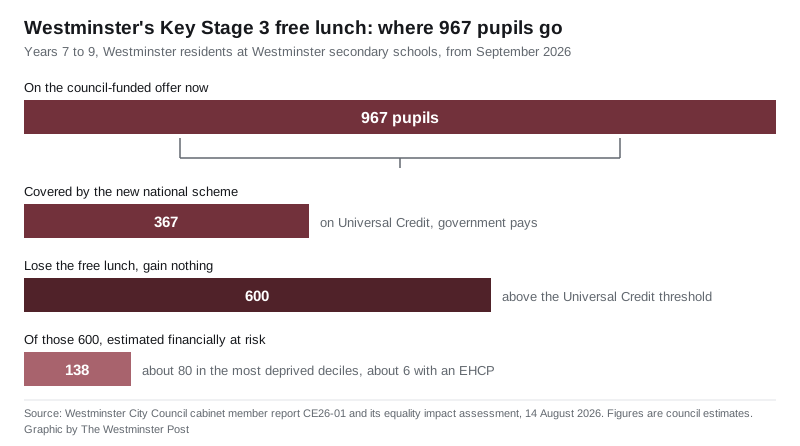
The offer currently feeds 967 pupils. By the council’s own estimate, about 367 of them will be picked up by the government’s expanded national scheme from September. The remaining 600 will not.
The council has not published a news release about it. The change appears only in the decision register and the cabinet member report behind it.
What the offer was, and who loses it
Since the 2023/24 academic year, Westminster has paid for a term-time lunch for pupils in Years 7 to 9 who live in Westminster, attend a Westminster secondary school, and do not qualify for government-funded free school meals. It was universal within that group, regardless of household income.
The money came from a shuffle. The Mayor of London launched free lunches for all London primary pupils in September 2023. Westminster was already funding its own primary offer, so it redirected the freed-up cash to Key Stage 3 pupils and to nursery children.
The cabinet member report sets out the scale of the cohort:
- 5,135 pupils are in Years 7 to 9 at Westminster schools, as of spring 2026
- 2,222 of them, 43%, live in Westminster
- 967 were eligible for the council’s Key Stage 3 offer, 18.8% of all Year 7 to 9 pupils
- 45 of the 967 have an Education, Health and Care Plan
- 57.9% live in the three most deprived deciles on the national deprivation index for children
(Cabinet member report CE26-01, PDF)
Why the council says the gap is closing
From September 2026 the government is extending free school meal eligibility in England to every child in a household receiving Universal Credit. The current test is a household income of no more than £7,400 a year. The Department for Education says over half a million more children will qualify. (Department for Education)
Nationally the DfE expects free school meal numbers to rise by about 38%. Westminster applied that figure to its own 967 and got roughly 367 pupils moving onto government funding. That leaves about 600 who lose a free lunch and gain nothing.
The council cannot yet be more precise. Councils cannot cross-reference Universal Credit data against the school census, so the real Westminster figure will not be known until the autumn 2026 census is published in December.
The report is also clear that the new national scheme creates two tiers. Pupils who qualify only through the expanded Universal Credit route will get a term-time meal, but not holiday activity and food provision, and their schools will not receive pupil premium funding for them.
The 138 the council expects to fall through
The most revealing numbers are in the equality impact assessment attached to the report. The council does not claim the 600 are all comfortable.
It uses its own Low Income Family Tracker data, which finds that around 23% of Westminster families not on Universal Credit are still financially at risk. Applied to the 600, that gives roughly 138 pupils from households under financial strain who will qualify for nothing.
Within that 138, the council estimates:
- about 80 live in the three most deprived deciles
- about 6 have an Education, Health and Care Plan
The assessment rates the impact on age, race and socio-economic group as negative. It notes that Global Majority groups are over-represented in lower-income households in Westminster, and that language barriers and low awareness can suppress free school meal registration.
The money
The 2026/27 budget for the offer was £597,300. Ending it in September saves £423,200 this financial year and a further £174,100 in 2027/28, after which the whole budget goes.
The report places the decision against a reported £6.336m overspend in children’s services. It also sets it against the council’s wider position that government is cutting its core funding from £219m to £119m. That is the subject of the budget consultation running until 30 September.
A phased withdrawal was costed and rejected. Running the offer to October half term would have cost £68,400 more; running it to the winter holidays, £131,400.
Timing, consultation and the safety net
The council’s own report concedes the point most parents will raise. Implementing from September, it says, “does not give families time to adjust financially to the changes”.
There was no public consultation. The report states there is “no general duty on the council to widely consult, simply because it is changing or ending a service”. Schools were consulted informally through secondary headteacher representatives. Most did not object in principle. One headteacher representative objected to both the principle and the timing. Schools were asked before the summer holidays to write to families warning that the offer would probably go.
The legal section flags a risk the council has to weigh: a legitimate expectation can arise from consistent past practice. It argues that the 2023 and 2024 decisions funding the offer were time-limited and subject to review, so no such expectation was created.
Families who lose the meal are directed to the council’s Crisis and Resilience Fund. That fund was itself cut ten days before this decision. On 4 August the cabinet member for value for money and finance approved £1.63m of savings from a £2.04m discretionary allocation, including reducing the Crisis Scheme from £1.5m to £0.5m. (Decision 3547, Westminster City Council)
What it means for you
If your child is in Year 7, 8 or 9 and lives in Westminster, check your free school meal eligibility now rather than in September. If anyone in your household receives Universal Credit, your child qualifies under the new national rules from the start of term, and you need to be registered for the school to claim. Apply through the government’s free school meals service.
If you are just above the Universal Credit line, you are in the group of roughly 600 with nothing to replace the meal. Registering still matters if your circumstances change during the year.
If you already receive free school meals on the old £7,400 test, nothing changes. You keep the meal, the holiday activity and food places, and your school keeps the pupil premium.
If your child is at primary school in Westminster, this decision does not affect you. The Mayor of London’s universal primary free meal programme continues, as do the council’s nursery meal offer and its enhanced holiday food provision at Easter, summer and Christmas.
If you want to object, the window has effectively closed. The decision was open to call-in by the policy and scrutiny committee until 21 August and takes effect on 22 August. The register recorded no call-ins.
We will report the real Westminster numbers when the autumn 2026 school census is published in December. We will also follow what the council’s promised letters to schools and families actually say at the start of term.
Sources
- Decision 3553: Westminster Key Stage 3 Pupil Meal Offer, Westminster City Council, 14 August 2026
- Cabinet member report CE26-01 (PDF) and its equality impact assessment (PDF)
- Decision 3547: Transition from the Household Support Fund to the Crisis and Resilience Fund, 4 August 2026
- Over half a million more children to get free school meals, Department for Education
Have your say