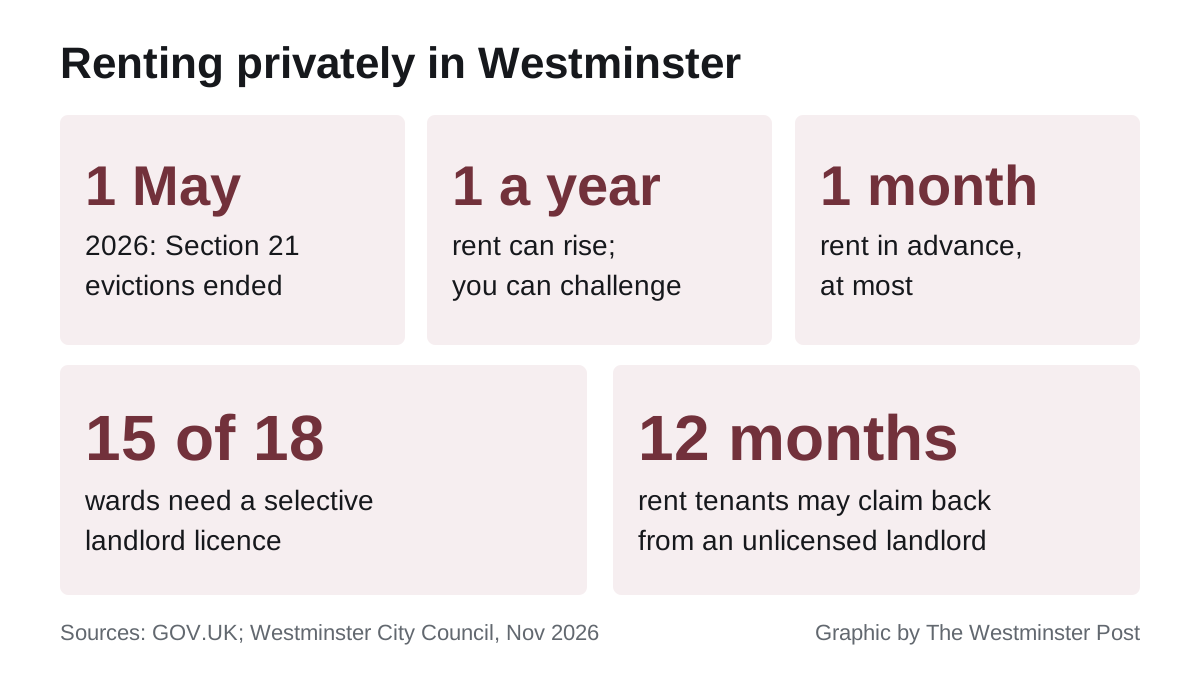

Private renting rights in Westminster since 1 May 2026: no Section 21, rent rises once a year, and landlords in 15 of 18 wards now need a council licence.
Private renting rights in Westminster changed more in 2026 than in the previous forty years. Since 1 May 2026 the Renters’ Rights Act has ended Section 21 “no-fault” evictions, turned fixed-term tenancies into rolling ones, limited rent increases to once a year and capped rent in advance at one month. On top of the national law, Westminster City Council now requires almost every private landlord in 15 of the city’s 18 wards to hold a licence, which gives tenants extra leverage when something goes wrong.
This page sets out what the law now says, how Westminster’s licensing schemes work, and who to contact about disrepair or an illegal eviction. It is a guide, not legal advice: for your own case, speak to the council’s Tenancy Relations Service, Citizens Advice or Shelter.
What changed on 1 May 2026
The government’s summary of the Act and Westminster’s own Renters’ Rights Act page list the main changes for private tenants in England:
- No more Section 21 evictions. A landlord can no longer end a tenancy without a reason. They can still seek possession on set grounds, such as selling, moving in, rent arrears or anti-social behaviour, through the courts.
- Rolling tenancies. Fixed terms have gone: private tenancies now run month to month or week to week with no end date. You can leave with two months’ notice.
- Rent rises once a year. A landlord can only raise the rent once a year, and you can challenge an increase you think is above the market rate.
- No bidding wars. A landlord or agent cannot accept more than the advertised rent.
- One month in advance, at most. Landlords cannot ask for more than one month’s rent up front.
- No blanket bans. It is now illegal to refuse a tenant because they receive benefits or have children.
- Pets. You can ask to keep a pet, and the landlord must consider the request reasonably.
The Act received Royal Assent on 27 October 2025. The main tenancy reforms took effect on 1 May 2026; later phases bring a national landlord database, rolled out area by area from late 2026, and a Private Landlord Ombudsman.
Westminster’s licensing schemes
Selective licensing: 15 of 18 wards
Since 24 November 2025, most privately rented homes in Westminster need a selective licence: a flat let to a family, to a single tenant, or to two people sharing. The scheme covers 15 wards in two designations:
- Designation 1 (poor housing conditions): Abbey Road, Church Street, Harrow Road, Knightsbridge and Belgravia, Little Venice, Maida Vale, Queen’s Park and Westbourne.
- Designation 2 (poor conditions and anti-social behaviour): Bayswater, Hyde Park, Lancaster Gate, Marylebone, Pimlico North, Regent’s Park and West End.
Pimlico South, St James’s and Vincent Square are not included. The council has a ward finder on its selective licensing page if you are not sure which ward you live in. A landlord who has applied can keep letting while the application is processed.
HMO licensing: shared homes everywhere
Shared houses and flats are covered across the whole city. Since 30 August 2021, Westminster’s additional HMO scheme has required a licence where three or more people from two or more households share a kitchen or bathroom, including shared flats in purpose-built blocks. The national mandatory scheme covers homes with five or more people in two or more households. The council says the additional scheme has been renewed.
Why licensing matters to tenants
Letting a licensable home without a licence is an offence. Westminster’s HMO page says it can lead to an unlimited fine on conviction or a civil penalty of up to £30,000, and tenants may be able to claim back up to 12 months’ rent through a rent repayment order. Licences also carry conditions on safety and management that the council can enforce. If you rent in a covered ward, it is worth asking your landlord for the licence number.
Disrepair: how to get it dealt with
- Report it to your landlord or agent in writing, by email or letter, and keep a copy. Westminster asks you to do this first, because a written report protects you from retaliatory eviction if the council later takes action.
- Give a reasonable time for the repair, and keep photos and dates.
- Report to Westminster’s Private Sector Housing Team if nothing happens. The online report poor housing conditions form is the fastest route; the duty officer is on res@westminster.gov.uk, or call 020 7641 6161 (9am to 5pm Monday, Tuesday, Thursday and Friday, 9am to 4pm Wednesday).
The council inspects using the Housing Health and Safety Rating System, which assesses 29 hazards including damp and mould, fire, falls, excess cold and overcrowding. It tries to resolve problems informally first, and takes formal action against the landlord where needed.
Council and housing association tenants follow a different route: council tenants go to their estate office (see our guide to Westminster council housing repairs), and housing association tenants use their landlord’s complaints process, then the Housing Ombudsman.
Harassment and illegal eviction
Changing the locks, removing your belongings, cutting off utilities or pressuring you to leave without a court order can be a criminal offence. Contact Westminster’s Tenancy Relations Service on 020 7641 1000 (option 4) or HSSTenancyRelations@westminster.gov.uk. If you are locked out or in danger, call the police on 999. If you are at risk of losing your home, the council’s homelessness service and our guides to the Westminster housing register and the CRF Housing Payment may help.
Westminster also publishes a Private Rented Sector Tenants’ Charter, in full and easy-read versions, setting out the standards it expects on damp and mould, unlawful eviction and unfair rent practices.
Frequently asked questions
Can my landlord still use Section 21 in Westminster? No. Section 21 notices are no longer valid for private tenancies in England from 1 May 2026. A landlord must use a legal ground for possession and go through the courts.
How often can my landlord put the rent up? Once a year. If you think the new rent is above the market rate, you can challenge it.
Does my Westminster landlord need a licence? Almost certainly, if you rent privately in one of the 15 wards in the selective scheme, or in a shared house or flat anywhere in the city. Homes in Pimlico South, St James’s and Vincent Square need a licence only if they are HMOs.
What happens if my landlord has no licence? The landlord commits an offence and can face a fine or a civil penalty of up to £30,000. You may be able to claim back up to 12 months’ rent through a rent repayment order.
How much notice do I need to give to leave? Two months, under the rolling tenancies introduced on 1 May 2026.
Who do I contact about damp and mould in a private rented flat? Your landlord first, in writing. If it is not fixed, report it to Westminster’s Private Sector Housing Team using the council’s online form.
Sources
- Ministry of Housing, Communities and Local Government, “When will the Renters’ Rights Act come into force?”, published 30 April 2026.
- Westminster City Council: Renters’ Rights Act (updated 19 March 2026), selective property licensing and “Do I need a licence?” (updated 12 June 2026), HMO licensing, private tenants, report poor housing conditions (updated 24 April 2026), and PRS Tenants’ Charter pages, read 7 November 2026.
Have your say