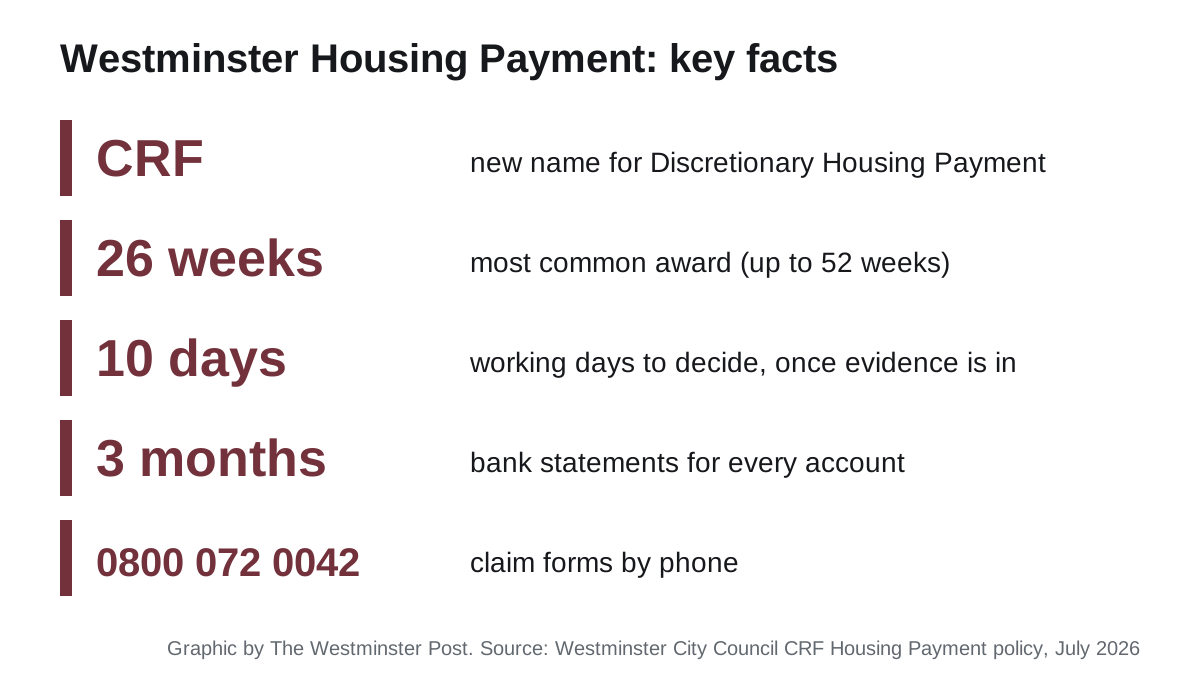

Westminster's Discretionary Housing Payment is now the CRF Housing Payment. Who can claim, the usual 26-week award, the evidence needed and how to appeal.
Westminster Discretionary Housing Payment still exists, but it has a new name. Since April 2026 Westminster City Council calls it the Crisis and Resilience Fund (CRF) Housing Payment, and the council’s page says plainly that it “is the new name for Discretionary Housing Payment”. It is the same idea: an extra payment towards your rent when your Housing Benefit or the housing part of your Universal Credit does not cover it all.
If you search the council website for “DHP” and find nothing, that is why. This page explains who can get the CRF Housing Payment, what the council looks at, how long awards usually last, what evidence to send and how to challenge a refusal. Everything comes from the council’s CRF Housing Payment page and its eight-page policy, last updated on 1 July 2026 and checked on 1 November 2026.
Why the name changed
Discretionary Housing Payments are now paid out of the Crisis and Resilience Fund, government funding that councils have administered since April 2026 under Department for Work and Pensions guidance. Westminster’s policy says its CRF has four parts: Crisis Payments, Housing Payments, Resilience Services and Community Coordination. The council describes its CRF as an £11 million, three-year programme running from April 2026 to March 2029, and it sets the Housing Payment budget from that fund each year.
That matters for you because the pot is shared. The policy is blunt: resources for Housing Payments are limited, and every claim depends on the budget available.
Who can claim
You can apply if you get either:
- Housing Benefit, or
- the housing element of Universal Credit,
and there is a gap between that benefit and your rent. You must have some entitlement to one of those benefits; the payment tops it up, it does not replace it.
It applies whether you rent from the council, a housing association or a private landlord, and it applies to households in temporary accommodation. Our page on temporary accommodation in Westminster explains how that system works.
What it can and cannot pay for
It can help with:
- a weekly or monthly shortfall between your benefit and your rent;
- the shortfall caused by the benefit cap;
- the shortfall caused by the spare room rule (the “bedroom tax”) in social housing;
- the gap caused by Local Housing Allowance limits on private rents;
- a short top-up for people moving into work who lose some benefit;
- rent arrears that are stopping you moving to a smaller home.
It cannot pay for:
- council tax (apply for Westminster Council Tax Support instead);
- charges included in your rent for fuel, water, food or other service charges that benefits do not cover;
- rent arrears from a period when you were not entitled to Housing Benefit or the Universal Credit housing element.
The policy does not list deposits or rent in advance among the things it pays for. If you are moving because the council is supporting a housing application, the council’s separate Local Support Payment can provide vouchers for a cooker, fridge, bed and bedding, for people on Housing Benefit or the Universal Credit housing element with savings under £3,000.
How the council decides
Every award is discretionary, so there is no automatic right to one. The policy lists what officers weigh for every claim:
- how much risk you face of becoming homeless;
- the effect a refusal would have on children, disabled people or anyone over state pension age in your home;
- your income and savings, and how far they could reasonably go towards the rent (Disability Living Allowance and Personal Independence Payment are not counted);
- the income of other adults living with you, who may be expected to pay more than the standard deduction.
Expect to pay something yourself. The policy says most applicants will be expected to contribute towards the shortfall unless there are exceptional circumstances, so “in the main, awards are unlikely to cover the full shortfall.”
Benefit cap cases
The council first checks whether you can cover the gap from your own income or savings. If not, it makes a time-limited award to give you a chance to move into work or increase your hours, or to claim a benefit that exempts you from the cap, or to move somewhere cheaper. If someone in the household has a serious health condition treated in Westminster, a child with an Education, Health and Care Plan at school here, a carer role, or one of the other circumstances listed in the policy, a longer-term award is more likely.
Spare room (bedroom tax) cases
The council looks at whether there are good reasons you cannot move to a smaller home: adaptations made for a disabled person, health conditions that make moving very hard, why the home was allocated with that many bedrooms, a risk of domestic abuse if you move, or a household member who is away for longer than the benefit rules allow. Your landlord can support your claim. If none of those apply, the council may still pay to clear arrears that are stopping you downsizing.
Private renters hit by Local Housing Allowance limits
The policy notes that the gap between private rents and Local Housing Allowance is “particularly wide in Westminster”, but it also says claims are unlikely to be agreed where someone has taken on a tenancy they could not afford. Where an award is made, it is meant to give you time to find somewhere cheaper, with help from the council’s Housing Solutions Service.
Moving into work
If you start work for the first time, or after a break of at least a year, and your benefit drops, the council can match the rent help you had before the job for three months, then taper it off over the following three months. This is normally a one-off.
How long an award lasts
Awards are for fixed periods and are not meant as a long-term fix. The policy says awards run for up to 52 weeks, and the most common period is 26 weeks. When it makes an award, the council sets out the steps it expects you to take, such as looking for cheaper housing, finding work or budgeting to pay more rent. Repeat claims are considered, but they are “only likely to be agreed where the council’s recommended actions have been followed”.
How to apply
- Apply online through the council’s CRF Housing Payment claim form, or download the Word form from the council’s page and send it back. You can also ask for a form at the Benefit Reception Office, 180 Vauxhall Bridge Road, SW1V 1ER, or by calling 0800 072 0042.
- Send three months of bank statements. New claims need statements for every bank, building society and Post Office account you hold, covering three recent, consecutive months and showing every transaction. This is the evidence most often missing.
- Add the rest of the evidence. Private renters must show the rent charged and the payments made. If you work, send a recent payslip. If you get Universal Credit, send proof of your current award.
- Wait for the decision. The council aims to tell you the outcome within ten working days of receiving everything it needs.
- Report changes. If your income, rent or household changes during the award, tell the council. Overpayments are taken from future awards or invoiced.
If you are refused
The decision letter must give detailed reasons and explain your right to a review. Ask for one in writing. A panel of councillors reconsiders the decision and makes a recommendation to the Cabinet Member for Finance and Council Reform, who decides. For a review you need bank, building society and Post Office statements covering six recent, consecutive months. The Cabinet Member’s decision is final; the only further challenge is judicial review, so get advice from Citizens Advice Westminster or a law centre before you reach that point.
If you are behind with rent and worried about eviction, contact the council’s Housing Solutions Service early, and see our guide to the Westminster housing register.
Frequently asked questions
Does Westminster still give Discretionary Housing Payments? Yes, under a new name. Since April 2026 the council calls it the Crisis and Resilience Fund (CRF) Housing Payment. It works the same way: an extra payment when Housing Benefit or the Universal Credit housing element does not cover your rent.
Who can get a CRF Housing Payment in Westminster? Anyone getting Housing Benefit or the housing element of Universal Credit who has a shortfall between that benefit and their rent. The council decides each claim on its circumstances and budget, so there is no automatic entitlement.
How long does a Westminster Housing Payment last? Awards run for a fixed period of up to 52 weeks, and 26 weeks is the most common. You can make a repeat claim, but it is only likely to succeed if you have followed the steps the council asked you to take.
Will the payment cover all of my rent shortfall? Usually not. Westminster’s policy says most applicants are expected to contribute towards the shortfall, and awards are unlikely to cover all of it unless there are exceptional circumstances.
How long does Westminster take to decide? The council aims to decide within ten working days of receiving all the information it needs, including three months of bank statements for every account.
Can I appeal if my claim is refused? You can ask in writing for a review. A panel of councillors reconsiders it and the Cabinet Member for Finance and Council Reform makes the final decision. You need six months of bank statements for the review.
Have your say