
Homeless households could be offered a private rented home, possibly outside London, and lose their place on the housing register. Have your say by 9 December.
Westminster City Council wants to start offering homeless households a private rented home instead of years in temporary accommodation. Some of those homes could be outside London.
A household that gets a suitable offer would come off the social housing register, whether it accepts the home or turns it down. The council is asking for views until 11.59pm on Wednesday 9 December.
The council announced the consultation on 29 October. It says 7,300 households are on its social housing register. Some larger families have waited more than 20 years.
The quick answer
- What: three changes to how Westminster allocates affordable housing, open for comment from 29 October to 9 December 2026.
- The big one: “Private Rented Sector Offers” to homeless households, which can be outside Westminster and outside London.
- The catch: if the council makes you a suitable offer, you leave the social housing register whether you say yes or no.
- Also proposed: removing the last “legacy” employment points, and widening who counts as a key worker for intermediate housing.
- Have your say: on the council’s consultation site. Each of the two surveys takes about ten minutes.
What a Private Rented Sector Offer is
At the moment, a homeless household owed the council’s main housing duty usually waits in temporary accommodation until a social home comes up. The council’s proposals page explains that the law does not require that home to be a social one. A suitable private rented home can end the duty.
The new policy would let the council make that private rented offer. It would also apply to some households owed the shorter “relief duty”, which lasts 56 days.
It would replace the current “Choosing the Private Rented Sector” approach. Under that, households who take a private home can stay on the register. Under the new policy they would not.
The council says each offer would be checked against the household’s circumstances, including:
- household size and the number of bedrooms needed
- medical needs and any adaptations
- affordability
- location and travel
- support and safeguarding needs
The council’s announcement adds employment, children’s schooling, caring responsibilities and support networks to that list. It says not everyone will be made an offer, because it will not suit every household. It promises free housing advice and help to resettle where a move is needed.
Why the council says it has to change
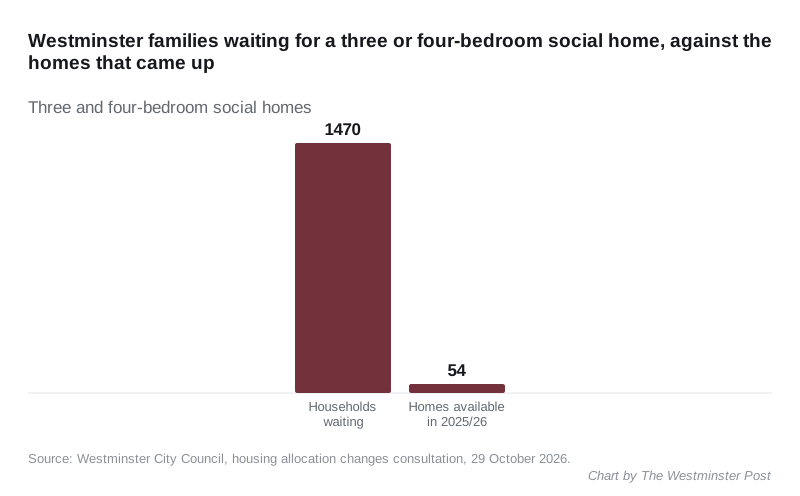
The proposals page sets out the gap for families who need a bigger home. 1,470 households are waiting for a three or four-bedroom social home. Only 54 homes of those sizes became available in 2025/26.
Private renting in the borough is expensive too. The council says a two-bedroom home costs at least £680 a week, and capped benefits do not cover rents at that level. That is why it expects some offers to be outside London, where rents are lower and larger homes easier to find.
Money is the other reason. The council has budgeted more than £60 million for temporary accommodation in 2026/27, and says its Government grant is being cut by more than £100 million over four years. We set out that cut and the council’s response in our story on its fair funding bid.
It also argues that a private tenancy is now more secure than it was, because the Renters’ Rights legislation has ended no-fault evictions.
Most London boroughs already make these offers, according to the council.
Employment points would go
Westminster removed employment points, which gave working households extra priority, from its allocations scheme in 2025. Households that already had them before 3 March 2025 kept “legacy” points for 36 months.
The council now proposes to remove those legacy points early. It says a legal ruling found they can indirectly discriminate against households who cannot work through no fault of their own, including carers and disabled people. Anyone holding them would lose that extra priority.
Who counts as a key worker
A separate survey covers intermediate housing: discounted homes to rent or buy for middle earners who cannot get social housing. 1,500 households are on the council’s intermediate list.
Key workers already have high priority, but these groups come ahead of them:
- social housing tenants
- serving military personnel
- some existing intermediate residents who need to move
- households on the social housing register
Today the definition covers only four groups:
- NHS clinical staff, excluding doctors and dentists
- public sector teachers, and teaching assistants with twelve months’ continuous work in Westminster
- police
- social care workers, with a professional qualification or twelve months’ continuous work in Westminster
The council wants views on widening it. It points to the borough’s 813,000 jobs, including many of London’s train, Tube and bus drivers and retail and hospitality staff.
What the council said
Cllr David Harvey, Cabinet Member for Housing and Regeneration, said: “It is neither fair nor compassionate for people to spend years in temporary accommodation when there is little realistic prospect of them securing a social tenancy in the near future. The reality is we need to be offering different solutions.”
He added that the council must “recognise people’s ties to their communities and provide appropriate support to help them settle and build their lives where relocating is required.”
What it means for you
- If you are in temporary accommodation or on the register as homeless, this affects you most. A suitable private offer, even one outside London, would end your place on the register if you refuse it. Say in the survey what support you would need to move.
- If you hold legacy employment points, you would lose the extra priority they give you.
- If you work in Westminster but are not a nurse, teacher, police officer or care worker, you may become eligible for key worker priority on intermediate homes. Say which jobs you think should count.
- Where to respond: the homelessness and allocations survey and the key worker survey. Both close at 11.59pm on 9 December.
- Read the current rules first. The council publishes its allocations scheme and its homelessness and rough sleeping strategy.
The council has not said when a final decision will be made. Its consultation site says the responses will be analysed to shape the final changes.
For how bidding and bands work now, see our guides to the Westminster housing register, temporary accommodation and housing transfers.
Have your say