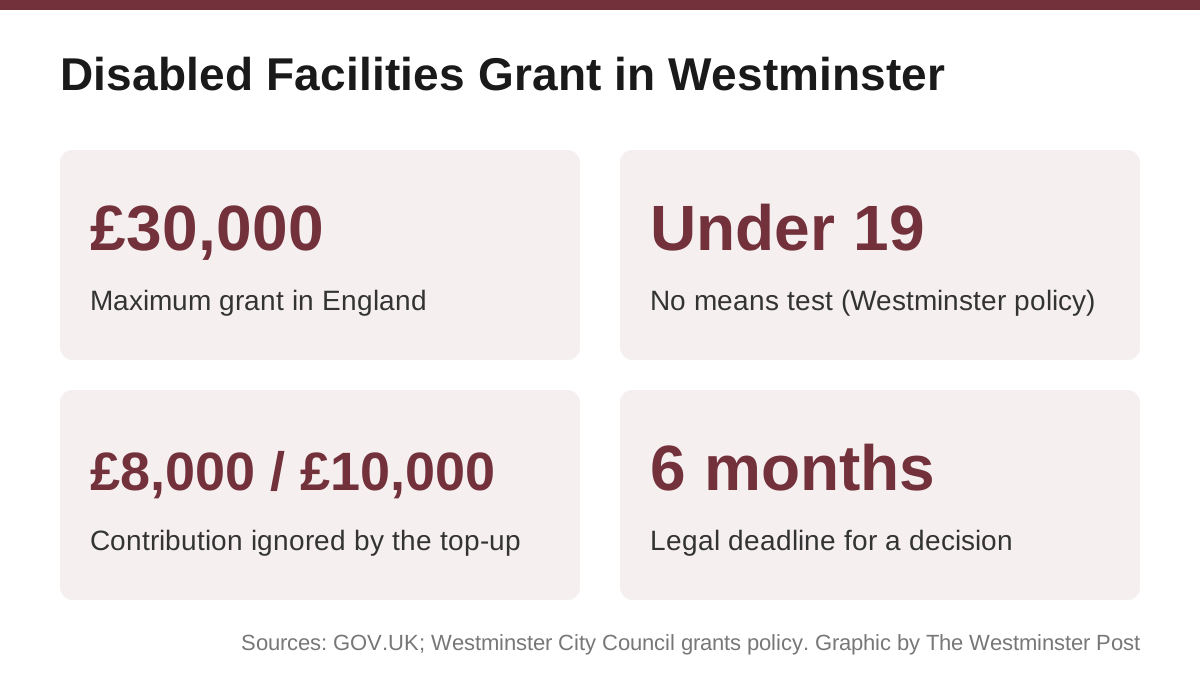

Disabled Facilities Grant in Westminster: up to £30,000, no means test for children, a top-up that cuts your contribution, and a 6-month decision deadline.
A Disabled Facilities Grant in Westminster pays up to £30,000 towards changes a disabled person needs to live safely at home: a level-access shower instead of a bath, a stairlift, ramps, wider doors, a downstairs bathroom. The council has a legal duty to provide it when the conditions are met. It is means tested for adults, so some people pay part of the cost, but Westminster runs its own top-up that shrinks that contribution, and applications for disabled children are not means tested at all.
This page sets out who qualifies, how the means test and the Westminster top-up work, what the council’s occupational therapists check, how long it takes, and the separate emergency grant for broken heating and hot water. It draws on the council’s housing adaptations, grants and assistance page, its Home Improvement Grants and Assistance Policy (last updated on the council site on 13 July 2026), its emergency heating grant page (updated 1 October 2026) and the GOV.UK Disabled Facilities Grants guide, all read on 26 October 2026.
What a Disabled Facilities Grant pays for
The council’s policy lists the typical works:
- taking out a bath and fitting a level-access shower
- widening doors and installing ramps
- stairlifts, or a downstairs bathroom, to reach rooms and facilities
- adapting heating or lighting controls so they are easier to use
GOV.UK adds improving access to the garden, extensions such as a downstairs bedroom, and a heating system suited to the disabled person’s needs. The grant does not affect any benefits you receive.
Who can apply
The disabled person must live in the home and intend to stay there for the grant period, which is usually five years (it can be shorter, for example for someone terminally ill). The application can come from the owner, a tenant or a landlord. Qualifying conditions are broad: physical disability, learning disability, age-related needs, autism, dementia and other cognitive impairments, progressive and terminal illness, and mental health conditions.
Council tenants follow a different route. Westminster’s adaptations page says council tenants who need grab rails, shower seats, door intercoms or larger adaptations should contact the Social Services Customer Services Centre on 020 7641 2500 for an assessment. Demand is high, so the council prioritises by need, and only the highest level of need is done immediately.
The assessment: two tests
Before any money is approved, two checks happen:
- “Necessary and appropriate”. An occupational therapist from Adult Social Care assesses the disabled person and decides whether the adaptation is needed to meet their needs.
- “Reasonable and practical”. The Westminster Home Improvement Agency then checks whether the work can be done, given the age and condition of the property.
That second test matters in Westminster’s older mansion blocks and listed terraces, where a lift shaft or a ground-floor bathroom may not be possible. Where the work cannot be done in the home, the council can instead help an owner-occupier who qualifies for a DFG to move, through a separate Relocation Assistance Grant that covers costs such as Stamp Duty, conveyancing, estate agent fees and removals, up to £15,000.
Remember that planning permission and building regulations approval are separate, and the council may ask you to use an architect or surveyor, whose fees the grant can cover.
The means test, and when it does not apply
For adults, the amount depends on household income and savings over £6,000, so some people are asked to pay a contribution. There are two important exceptions:
- Children. GOV.UK says disabled children under 18 can get a grant without their parents’ income being counted. Westminster’s own policy goes further: it says applications for a disabled person under 19 are not means tested.
- Landlords applying for a tenant are not means tested on their own income and savings, though the council may ask for the home to be let to another disabled person if the tenant moves within five years.
Westminster’s top-up: Adaptations Assistance
This is the part most residents do not know about. Under its discretionary policy, Westminster offers Adaptations Assistance to owners and private tenants who face a means-test contribution. It pays the gap between the cost of the works and your assessed contribution after the council has ignored part of that contribution:
- the first £8,000 of your contribution is disregarded if you do not receive a disability benefit
- the first £10,000 is disregarded if you do receive a disability benefit
The combined help is capped at £30,000 per applicant in any five years, and the home must not have a market value above £1.5 million, judged on average sold prices over the past year. Anything you ask for beyond what the occupational therapist recommends is between you and your builder and is not funded.
If you choose to arrange the work yourself rather than let the council do it, you need at least two quotes from VAT-registered contractors, and one of them must do the work.
How long it takes
By law, the council must give you a decision within six months of your application. Once approved, the work should be finished within 12 months. Do not start any work before approval: both GOV.UK and the council’s policy say work done beforehand may not be paid for.
The council pays on satisfactory completion, either to you or directly to the contractor, against invoices and guarantees. If the work comes in cheaper than approved, it pays the lower figure.
If a past adaptation needs fixing
Westminster also runs a discretionary grant for repairing an existing adaptation, or renewing an expired or nearly expired warranty on one, such as a stairlift. It covers the full cost up to £5,000 in any five years for the same home, for owners and private tenants.
Emergency heating and hot water grant
Separate from the DFG, the council’s emergency works grant covers repairing or replacing broken heating or hot water. It is means tested, with a maximum of £4,000 in any one financial year and £6,000 over five years. You must be an owner-occupier or a private tenant responsible for repairs, live there as your main home, lack adequate heating or hot water, and either be aged 60 or over or be the parent or guardian of a child under 16 and receive a qualifying benefit.
The council’s list of qualifying benefits includes Housing Benefit, Local Council Tax Support, Pension Credit, income-related ESA, income-based Jobseeker’s Allowance and Income Support, plus Universal Credit, Working Tax Credit or Child Tax Credit where household income is under £15,910.
How to apply
Contact the Westminster Home Improvement Agency on 020 7641 8959 or HIA@westminster.gov.uk, or start with an occupational therapy assessment through Adult Social Care. If your case falls outside the policy, the agency can put it to the council’s “Out of Policy” Grants Panel. If you disagree with a decision, you can appeal to the council and then complain to the Local Government and Social Care Ombudsman. The government-funded charity Foundations can also help with applications.
For smaller jobs that do not need a grant, see our guide to the free Westminster handyperson service. If you are on a low income, check our pages on Westminster council tax discounts and the Blue Badge in Westminster.
Frequently asked questions
How much is the Disabled Facilities Grant in Westminster? Up to £30,000, the maximum for England. Westminster’s Adaptations Assistance can reduce what you pay towards it, within a combined £30,000 limit per applicant over five years.
Is the Disabled Facilities Grant means tested in Westminster? For adults, yes: household income and savings over £6,000 are assessed. Westminster’s policy says applications for a disabled person under 19 are not means tested, and landlords are not means tested either.
How long does a Disabled Facilities Grant take in Westminster? The council must decide within six months of your application, and the work should then be completed within 12 months. Occupational therapy assessments are prioritised by need.
Can I get a Disabled Facilities Grant if I rent? Yes. Private and housing association tenants can apply, and so can landlords on a tenant’s behalf. Westminster council tenants should contact Social Services on 020 7641 2500 for an adaptations assessment instead.
Can I start the work before the grant is approved? No. GOV.UK and the council’s policy both warn that work started before approval may not be paid for. Wait for written approval.
What if my heating breaks and I cannot afford the repair? Westminster’s emergency heating and hot water grant pays up to £4,000 a year, and £6,000 over five years, for eligible owners and private tenants aged 60 or over, or parents of a child under 16, on qualifying benefits.
Have your say