

Westminster will formally ask ministers to rethink a £100m, 46% grant cut. 89.8% of consultation answers backed the bid; the sign-off is due Thursday.
Westminster City Council is about to use a little-known law to ask the Government to rethink a cut of about £100m to its grant.
The council says the Fair Funding Review would cut its Government grant by 46%. With rising costs, demand and inflation on top, it puts the budget gap at £160m by the end of 2028/29. (Cabinet Member report VFM26-23)
Cllr Paul Fisher, Cabinet Member for Value for Money and Finance, is due to approve the submission on Thursday 22 October. (Decision record 3607)
The quick answer
- What: a formal proposal to the Secretary of State under the Sustainable Communities Act 2007, asking for changes to how Westminster is funded.
- Why: the council says its Government grant falls by about £100m, leaving a £160m gap by 2028/29.
- Who backed it: 89.8% of answers to the council’s September consultation supported or strongly supported the bid. 1,376 people responded.
- The catch: the Government does not have to accept any of it.
What the council is asking for
The draft submission sets out four asks, in the order residents ranked them. (Appendix A, draft submission)
- Keep more of the money raised in Westminster. A baseline 5% share of business rates, income tax and stamp duty collected in the borough, plus any growth. At least 50% of new locally targeted taxes, naming the High Value Council Tax Surcharge and the Overnight Visitor Levy.
- More money where demand is growing. This includes paying housing benefit for temporary accommodation at actual cost rather than a 2011 rate. It also asks for help with very expensive children’s and adult social care placements.
- More time. The cut would be spread over at least eight years, two council terms, rather than pushed onto council tax quickly.
- More freedom to raise income. Fees set at full cost recovery, licensing fees uprated with inflation, and wider uses for parking income.
It also asks ministers to cap the council tax rises assumed in their funding sums at the normal referendum limit.
The council is not acting alone. The draft says it is submitting alongside the Royal Borough of Kensington and Chelsea and Wandsworth, and the three support one another’s bids.
What residents said
The council consulted from 8 to 30 September. It received 1,376 responses, according to the consultation report; the draft submission gives 1,378. (Appendix B, consultation report)
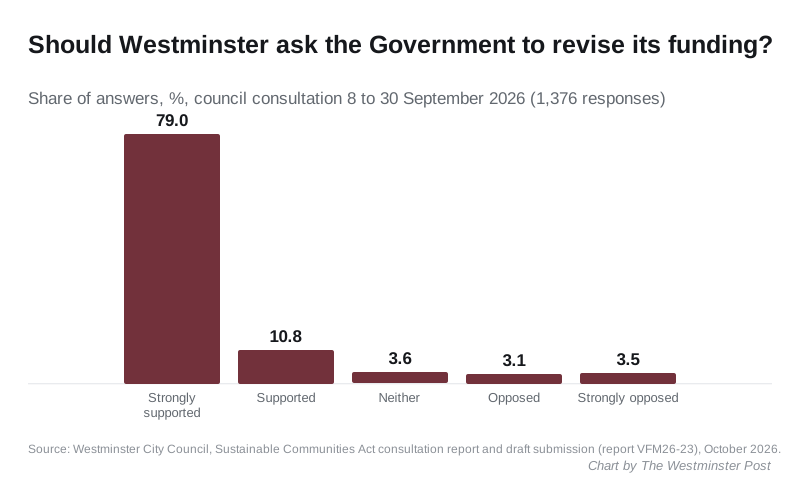
| Answer | Share |
|---|---|
| Strongly supported | 79.0% |
| Supported | 10.8% |
| Neither | 3.6% |
| Opposed | 3.1% |
| Strongly opposed | 3.5% |
Asked what more money could improve, people most often picked public safety and the local environment, each 25.8% of selections. Lower living costs (13.7%) and better health (13.1%) came next. People could pick more than one, so these are shares of answers, not of people.
The consultation report sums up the written comments. Many said the funding formula ignores Westminster’s large daytime and visitor population. Many were worried about steep council tax rises, especially for older people, people living alone and lower-income households.
The report also records a small minority who backed more redistribution to poorer areas. Some said Westminster has room to raise more through council tax. Others questioned how the consultation was framed.
What it means for you
Nothing changes on your bill because of this decision. The submission costs nothing beyond staff time, the report says, and it is “not a judicial action”.
The report is also plain that ministers can say no. “There is no statutory obligation on the Secretary of State to accept a proposal,” it says.
The bigger decisions are still to come:
- Council tax: our budget gap story explains how a doubled council share of band D would compare with Camden and Brent.
- Council Tax Support: the council is consulting until Thursday 12 November on making working-age claimants pay 10% to 30% of their bill. See our Council Tax Support story.
- The Budget: the draft says the Government’s roadmap to fiscal devolution is due alongside the Budget on Wednesday 28 October.
Your band is on our council tax bands page.
The background
The council’s own case leans on what it calls the borough’s national role. It says Westminster adds more than £76bn in economic output, and that 51% of its income already comes from rent, sales, fees and charges.
It also says it spends 17% of its budget on housing, temporary accommodation and rough sleeping support. About 28% of London’s street homelessness is in Westminster, according to the draft.
A band D home in Westminster pays £1,048 this year, against £2,207 in Camden, according to the council’s budget consultation. The draft asks that councils which “historically run balanced budgets and maintained low council tax rates are not treated differently as a result”.
If the submission is approved on Thursday, the Director of Policy and Strategy will send it to the Ministry of Housing, Communities and Local Government. A covering letter from the Leader of the Council goes with it.
Have your say