
Westminster Council Tax Support pays up to 100% of the bill in 2026/27 if your income is low and savings under £16,000. Who qualifies, how to claim, backdating.
Westminster Council Tax Support can pay all of your council tax bill in 2026/27. The council’s scheme still pays up to 100% of the charge for both working-age and pension-age residents on a low income, whether you rent or own your home, provided your savings are £16,000 or less. How much you get depends on your income, your age, your savings and who lives with you. It is taken off your council tax bill rather than paid to you.
This page explains the 2026/27 rules, from Westminster City Council’s published Council Tax Support scheme for 2026/27 and its benefits guide, checked on 28 October 2026. The working-age scheme may change from April 2027: the council is consulting on it until midnight on 12 November 2026, and we cover the options in Westminster’s Council Tax Support cut plan.
Who can get it
You can claim if you pay council tax on your home in Westminster and:
- you are on a low income or receive benefits such as Universal Credit or Pension Credit;
- your savings and capital, including a partner’s, are £16,000 or less (unless you receive the Guarantee Credit part of Pension Credit, in which case savings do not count against you).
You can get support whether you rent from the council, a housing association or a private landlord, or own your home. The council’s own wording: it “could help pay towards some, or all, of your Council Tax bill if you are on a low income, even if you own your own home.”
How much you can get
The maximum is 100% of your bill. The scheme sorts claimants into three classes:
| Class | Who | What you get |
|---|---|---|
| 1 | Your income is below your “applicable amount” | 100% of the bill, less any non-dependant deductions |
| 2 | Your income is above your applicable amount | The full bill, less 20% of the difference, less any non-dependant deductions |
| 3 | You have at least one second adult living with you | 100%, 25%, 15% or 7.5%, depending on the second adult’s circumstances |
The applicable amount is the government’s figure for a household’s basic weekly living costs. For 2026/27 it is £95.55 a week for a single person aged 25 or over, £75.65 if under 25, and £150.15 for a working-age couple, with additions for children, disability and caring. For a household on Universal Credit, the applicable amount is the maximum UC the household could receive, compared with the actual award plus other income.
Class 2 is the one most people in work fall into. In plain terms: every £10 a week of income above your applicable amount reduces your support by £2 a week. So support tapers off gradually as your income rises rather than stopping dead.
Pensioners and working-age people are treated differently
If you have reached State Pension age, your support is worked out under national rules set by the government, and Westminster cannot change them. The applicable amounts are much higher: £238.00 a week for a single person who reached pension age on or after 1 April 2021, and £363.25 for a couple who both did.
If you are of working age, Westminster’s local scheme applies. For 2026/27 it uses the same calculation, so working-age claimants can also get up to 100%. That is the part the council’s consultation proposes to change.
War pensions are ignored in full for both groups.
Savings
| Savings ignored | Savings that reduce support | Savings that stop support | |
|---|---|---|---|
| Working age | £6,000 or less | £6,000 to £16,000 | Over £16,000 |
| Pension age | £10,000 or less | £10,000 to £16,000 | Over £16,000 |
Between the limits, the council adds “tariff income” to your weekly income. For working-age claimants that is £1 a week for every £250, or part of £250, above £6,000. For pension-age claimants it is £1 a week for every £500 above £10,000. If you receive Guarantee Pension Credit, no tariff income is counted.
If other adults live with you
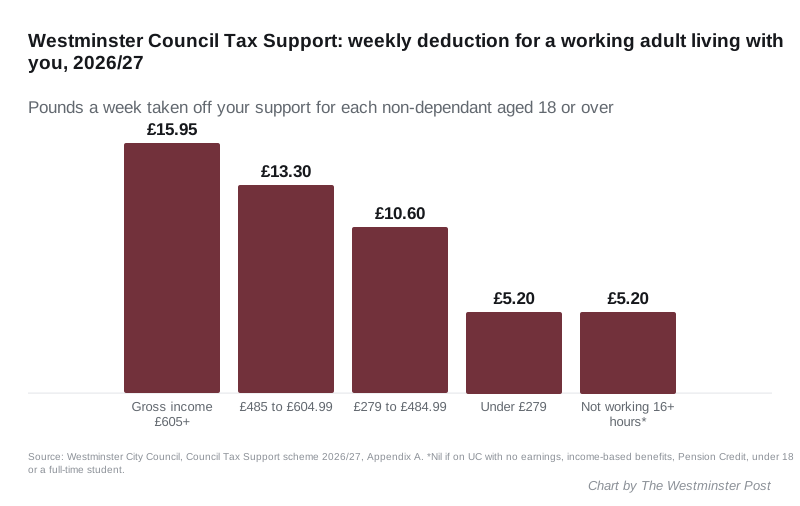
If an adult son, daughter or other relative lives with you (a “non-dependant”), the council assumes they contribute and takes a fixed weekly amount off your support. In 2026/27, for a non-dependant working at least 16 hours a week:
| Their gross weekly income | Weekly deduction |
|---|---|
| £605.00 or more | £15.95 |
| £485.00 to £604.99 | £13.30 |
| £279.00 to £484.99 | £10.60 |
| Under £279.00 | £5.20 |
There is no deduction if the non-dependant is under 18, a full-time student, receives Pension Credit, Income Support, income-based Jobseeker’s Allowance or income-related ESA, or receives Universal Credit with no earnings. Other adults who are not working 16 hours a week have a £5.20 deduction.
How to claim
There are three routes, according to the scheme document:
- Online: Westminster’s joint Housing Benefit and Council Tax Support form. Paper forms are available on request.
- If you already get Housing Benefit: a shortened Council Tax Support form.
- Through Universal Credit: tell the DWP you want to claim Council Tax Support as part of your UC claim.
If you claim Pension Credit, Income Support, Jobseeker’s Allowance or ESA, you will also be asked to claim Housing Benefit and Council Tax Support at the same time.
For help with a claim, call the council’s benefits helpline on 0800 072 0042, email westminster.benefits@secure.capita.co.uk, or visit the customer service centre at 180 Vauxhall Bridge Road, SW1V 1ER.
Backdating
Claim as soon as you think you qualify. Working-age support normally starts from the date you claim. It can be backdated up to six months if you had good cause for claiming late: being ill with nobody to claim for you, being wrongly advised by an official body, or not understanding you could claim because of age, language or similar reasons. Ask in writing, giving the dates and your reasons with evidence.
If you have reached pension age, support can be backdated up to three months before your claim, as long as you met the conditions in that time.
Changes and disputes
You must tell the benefits service straight away about anything that could affect your award: a change in income or savings, someone moving in or out, or a household member becoming a full-time student. If your support goes down, you will get a new council tax bill.
If you disagree with a decision, write to the council asking for a review. It has two months to respond. If it does not, or you still disagree, you can appeal to the Valuation Tribunal within two months of the council’s response, or four months from your review request if the council never answers.
Other ways to cut the bill
Council Tax Support is separate from discounts and exemptions. A single person discount (25% off), the disabled band reduction and the carer discount are applied first and can be combined with support. Our guide to Westminster council tax discounts covers each of them, and Westminster council tax bands gives this year’s charge for every band.
Frequently asked questions
How much Council Tax Support can I get in Westminster? Up to 100% of your bill in 2026/27, for both working-age and pension-age claimants. The amount depends on your income, savings, age and who lives with you. If your income is above the government’s applicable amount, support reduces by 20p for every £1 over.
What is the savings limit for Council Tax Support in Westminster? £16,000, including a partner’s savings. Working-age savings up to £6,000 are ignored and pension-age savings up to £10,000. If you receive Guarantee Pension Credit, savings do not count.
Can I get Council Tax Support if I own my home? Yes. Westminster says support can help with some or all of the bill on a low income “even if you own your own home”.
How far back can Westminster backdate Council Tax Support? Up to six months for working-age claimants with good cause for claiming late, and up to three months for people of pension age.
Is Westminster cutting Council Tax Support? It is consulting until 12 November 2026 on asking working-age claimants to pay 10%, 20% or 30% of their bill from April 2027, or keeping the current scheme. Pensioners are on national rules and would not be affected.
Does Universal Credit include council tax? No. Universal Credit does not cover council tax, so you need to claim Council Tax Support separately, either through the council or by telling the DWP during your UC claim.
Have your say