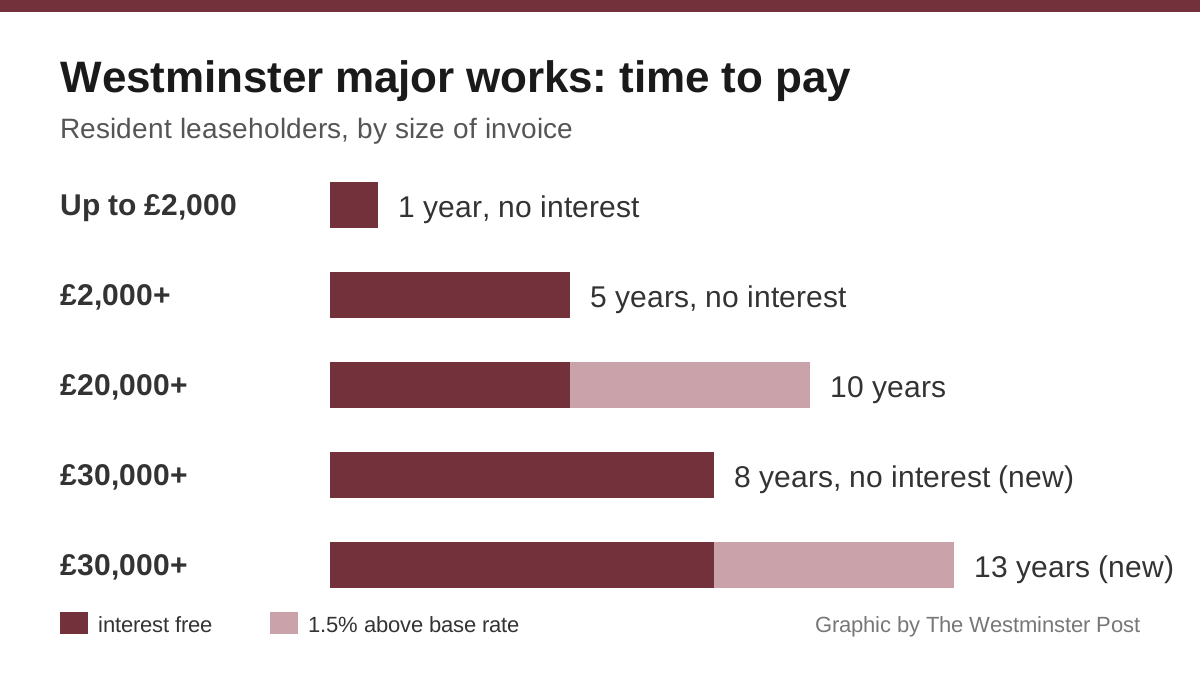

Westminster major works bills: resident leaseholders owing £30,000 or more can now take 8 years interest free, or 13 years. Every payment option.
If you are a Westminster major works leaseholder facing a bill for new windows, a roof or a full repairs and decorations scheme on your block, the council has just changed what you can do about it. Resident leaseholders with a major works invoice of £30,000 or more can now spread it over eight years with no interest at all, or over 13 years with the first eight interest free. The council has also dropped the rule that you had to prove you could not borrow elsewhere before it would lend to you.
This page sets out every payment option on Westminster City Council’s list, how a major works project runs from first survey to final bill, what the Section 20 and Section 20B letters mean, and where to go if you think the charge is wrong. It draws on the council’s major works payment plans page (last updated 6 October 2026), its announcement of the new options (23 September 2026) and its major works stage pages, all read on 24 October 2026.
What changed in September 2026
The council said it was bringing in the new options “in response to the rising cost of living and increased building costs”. Two are new, both for resident leaseholders with invoices of £30,000 or more:
- 8 years in equal monthly instalments, interest free.
- 13 years in monthly instalments, with the first 8 years interest free.
The second change matters for anyone who was turned away before: the council has removed the requirement for leaseholders to show they cannot secure alternative lending before taking one of its loans.
Every major works payment option
| Invoice | Option | Interest | Who can use it |
|---|---|---|---|
| Up to £2,000 | 1 year, equal monthly instalments | None | All leaseholders |
| £2,000 and above | 2 years, equal monthly instalments | None | All leaseholders |
| £2,000 and above | 5 years, equal monthly instalments | None | Resident leaseholders |
| £20,000 and above | 10 years, monthly instalments | None for 5 years, then 1.5% above Bank of England base rate | Resident leaseholders |
| £20,000 and above | Repayment loan, secured on the home, up to 25 years | None for 8 years, then 1.5% above base rate | Resident leaseholders; others case by case |
| £20,000 and above | Deferred payment loan, secured on the home, repaid on sale | None for 8 years, then 1.5% above base rate | Resident leaseholders; others case by case |
| £30,000 and above | 8 years, equal monthly instalments | None | Resident leaseholders |
| £30,000 and above | 13 years, monthly instalments | None for 8 years, then 1.5% above base rate | Resident leaseholders |
“Resident leaseholder” means you live in the flat. The council’s page shows the longer plans as not available for non-resident leaseholders, meaning flats that are sublet or company owned; for the two loans, it says non-resident cases are assessed case by case. For either loan, the administration cost can be added to the amount borrowed.
The deferred payment loan is the one to know about if you are retired or on a low income. You make no payments at all; the loan is secured by a legal charge on the flat and repaid in full when it is sold. Interest starts after eight years, so it is not free money, but it means a large bill does not have to come out of your income.
If you already have a payment agreement, the council says you can ask to change it. Call Leasehold Operations on 0800 358 3783.
How a Westminster major works project runs
The council describes four stages. Knowing where your block is tells you when you can still influence the works and the bill.
1. Initial planning. Works are programmed up to five years ahead by the council’s Asset Strategy team, based on repairs history and the age of parts of the building such as windows. Between 18 and 12 months before works are due, the team surveys the block and prepares budget estimates, then writes to residents with the proposed works and timetable and asks for feedback. This produces a Client Brief, which is published on the council’s website.
2. Design and approval. The term contractor for your area draws up a plan and its own cost estimates. Surveys for asbestos and lead are done, any ballots held and planning approval sought. The contractor’s final proposal is published, and then leaseholders are sent a Section 20 Notice of Estimate.
3. Onsite. The contractor is responsible for the work and for talking to residents, and every project has a dedicated resident liaison officer. Raise problems with the contractor first. Near the end, residents are invited to an end of works inspection.
4. Completion. Once the council signs the work off, a 12-month defects period starts. Faults in that year go back to the contractor; urgent ones, such as a leak in a new roof, straight away, and cosmetic ones, such as failing paintwork, at the end of the period. Big items such as new roofs and windows also carry manufacturers’ guarantees for longer.
The council notes that smaller jobs, such as fire safety works or emergency lighting upgrades, may follow a different process.
The Section 20 Notice of Estimate: your 37 days
The Notice of Estimate is the letter that matters most. It describes each part of the works and why it is needed, gives the project cost and your estimated individual share. Westminster gives leaseholders 37 days to make written observations.
Use them. Write down anything you think is unnecessary, already done recently, or priced too high, and send it in within the deadline. The council says that depending on the size of the bills it offers one-to-one surgeries where leaseholders can discuss the payment options. Book one if your share is large.
The law behind the letter is section 20 of the Landlord and Tenant Act 1985: a landlord must consult leaseholders before carrying out works that would cost any one of them more than £250, or it cannot recover more than that from each leaseholder unless a tribunal agrees.
The Section 20B letter is not a bill
Months after the works, you may receive a Section 20B notice. It is not an invoice and does not change your balance. Under section 20B of the Landlord and Tenant Act 1985, a landlord has 18 months to either bill a cost or tell you it has been incurred, so the council sends it to protect its right to charge you later while the final account is still being agreed.
The figure on it is the cost to the whole block so far, including work leaseholders will not be charged for. Your final share may be lower once those items come out, or higher if work was still going on. You may receive one letter for each project on your block.
Estimate, final account and how your share is worked out
You are first billed on the estimate. When the contract is finished and full costs are confirmed, the council prepares a final account and sends a final invoice with a breakdown of the works; your account is then adjusted up or down. The council says the invoice will not explain why the figure changed from the estimate, but it will provide that justification on request. Ask for it.
Costs are shared across the block or estate by bed spaces: the number of bed spaces in your flat compared with the total in the block or estate. Larger flats pay a larger share.
Major works bills are separate from your ordinary service charge, which Westminster now bills once a year in March, payable in two halves before 1 April and 1 October or in 12 monthly instalments, with a statement of actual spend each September.
If you think the bill is wrong
- Ask for the breakdown and the justification for any change between estimate and final account.
- Speak to Leasehold Operations about the figures and the payment options before the payment date.
- Apply to the tribunal. If you think a charge is unreasonable or the work was not done to a reasonable standard, the First-tier Tribunal (Property Chamber) can decide whether a service charge is payable and how much. The government’s housing tribunal guidance explains how to apply.
You can also get free advice from the Leasehold Advisory Service. If money is the problem rather than the figure, our guide to Westminster council tax discounts may help, and our council housing repairs page covers ordinary repairs in council blocks.
Frequently asked questions
Can I pay a Westminster major works bill in instalments? Yes. Every leaseholder can spread an invoice over 1 year (up to £2,000) or 2 years (£2,000 and above) interest free. Resident leaseholders can also choose 5 years interest free, 10 years for bills of £20,000 or more, and, since September 2026, 8 years interest free or 13 years for bills of £30,000 or more.
What is the longest Westminster will let me take to pay? Its repayment loan, secured on your flat, can run for up to 25 years for bills of £20,000 or more, with the first 8 years interest free. A deferred payment loan needs no repayments at all until the flat is sold.
Do I have to prove I cannot get a mortgage or loan elsewhere? Not any more. In September 2026 the council removed the requirement for leaseholders to show they cannot secure alternative lending before using its loans.
How long do I have to respond to a Section 20 Notice of Estimate? Westminster gives leaseholders 37 days to make written observations on the works and costs set out in the notice.
I have a Section 20B letter. Do I have to pay it? No. A Section 20B notice tells you costs have been incurred on your block; it is not an invoice and does not change your account. Your share is billed later in the final account, and it may be higher or lower than the figure on the letter.
What if something goes wrong after the works finish? There is a 12-month defects period after the council signs the works off. Report faults and the contractor is called back; larger items such as roofs and windows also carry longer manufacturers’ guarantees.
Have your say