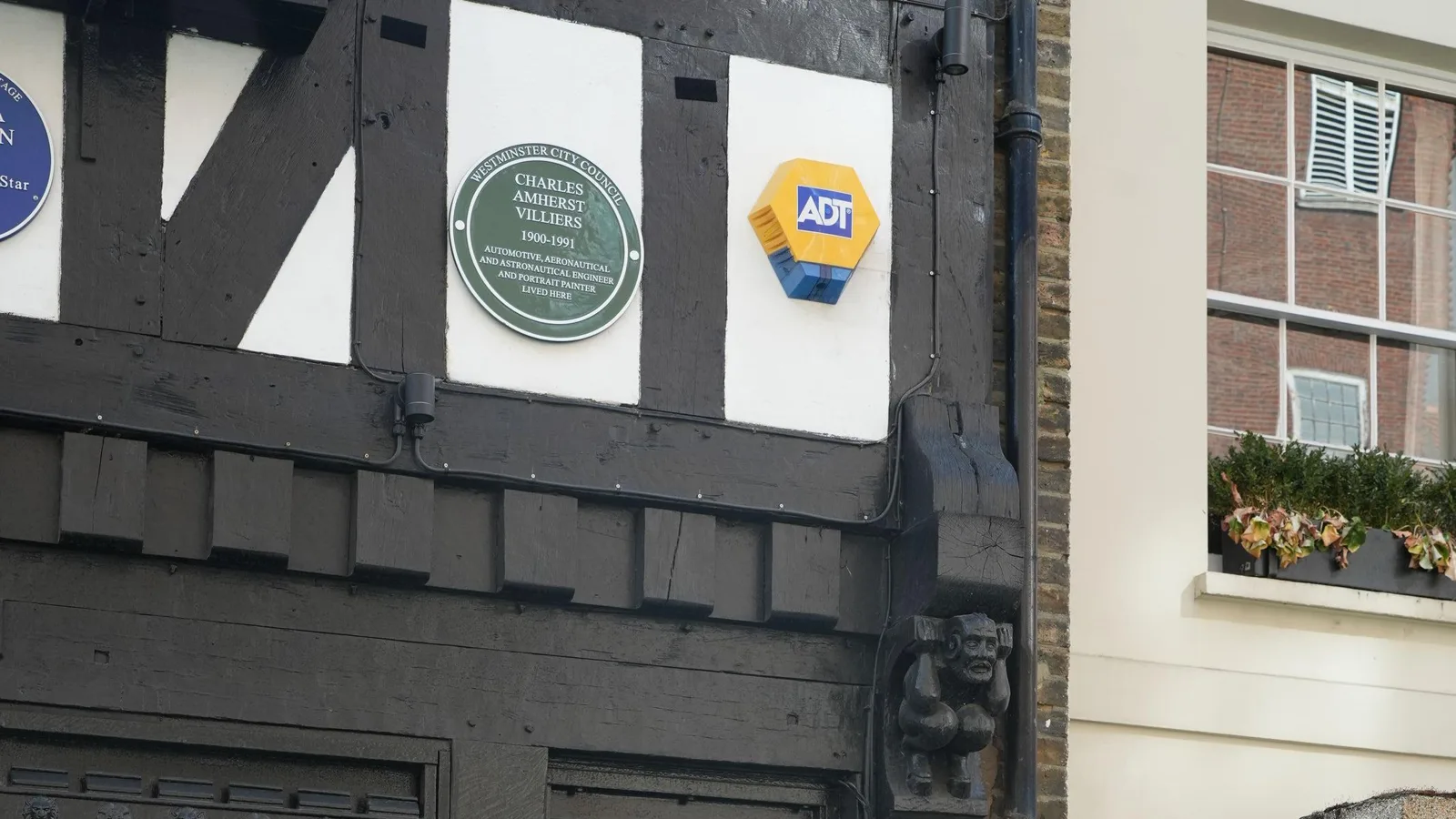

A green plaque now marks 22 Farm Street, Mayfair, home in the 1930s of Charles Amherst Villiers, who supercharged the Blower Bentley and helped inspire Bond.
A new Westminster green plaque has gone up on 22 Farm Street in Mayfair. It marks the home of Charles Amherst Villiers, the engineer behind the supercharger on the Blower Bentley.
The plaque was unveiled on Monday 5 October. (Westminster City Council)
Villiers lived at Farm Street from 1932 to 1938, during his first marriage. The original building still stands, according to the council’s report. (Cabinet Member report, 28 July 2026)
The plaque reads:
CHARLES AMHERST VILLIERS 1900-1991
AUTOMOTIVE, AERONAUTICAL AND ASTRONAUTICAL ENGINEER AND PORTRAIT PAINTER
LIVED HERE
Who he was
The council report sets out a career that is hard to fit on one plaque:
- Land speed records. He helped Malcolm Campbell design an early Blue Bird, the first car built specifically to break the land speed record. He left before it was finished in 1926.
- The Blower Bentley. Racing driver Sir Henry “Tim” Birkin asked him to supercharge Bentley’s 4½ litre car, against the wishes of W.O. Bentley himself. In March 1932 Birkin’s Blower Bentley set the Brooklands Outer Circuit lap record at 137.96mph. It stood for two years.
- James Bond. Villiers was a close friend of Ian Fleming. Fleming gave Bond a supercharged Bentley in the early novels and drew on Villiers’ engineering for Chitty Chitty Bang Bang. Villiers later painted Fleming’s portrait.
- War and space. He flew military aircraft for the Air Transport Auxiliary, then moved to North America. In the US he worked in aerospace, including on Boeing’s Lunar Systems Group.
- Formula One. Back in Britain in the 1960s he consulted for BRM and for Graham Hill’s Embassy Hill team, and painted Hill too.
He died on 12 December 1991, aged 91.
How the plaque came about
The building’s owner nominated Villiers and paid for the plaque. Westminster’s scheme costs the council nothing to install: the report puts the sponsorship fee at £3,500 plus VAT. The council pays only for any future repairs.
An independent panel backed the nomination. It includes a Westminster guide lecturer, a University of Westminster historian, the council’s archives lead and a researcher from UCL’s Survey of London. The cabinet member for resident services and civic pride, Councillor Robert Rigby, approved it on 28 July and unveiled it this week.
He said Villiers “had an extraordinary life”, and that his “story reached into so many different parts of twentieth-century history”.
Paul Kenny, author of the biography The Man Who Supercharged Bond, supported the nomination. In the report he wrote: “If Villiers had stuck to one discipline, he would be as well-known as Brunel.”
The plaques are cast from 100% recycled metal, the report says.
What it means for you
To see it, go to 22 Farm Street in Mayfair. The plaque is on the half-timbered front of the building, above the door.
To nominate someone, the council’s green plaques page has the criteria. People must be regarded as eminent in their field or have made a genuine contribution to society, and enough time must have passed to show it lasted. A sponsor has to be in place before you nominate, and the building owner must agree.
This is the second green plaque decision in Mayfair and Soho in recent weeks. In September the council approved one for the painter Angelica Kauffman in Golden Square.
Sources
- Westminster City Council: Westminster honours engineer who helped inspire the world of James Bond, published 5 October 2026, for the unveiling and the quotes from Cllr Rigby.
- Cabinet Member report RSCP26-02, 28 July 2026, on the council’s decision record, for the address, dates, wording, career details, sponsorship fee, panel and Paul Kenny’s statement.
Have your say