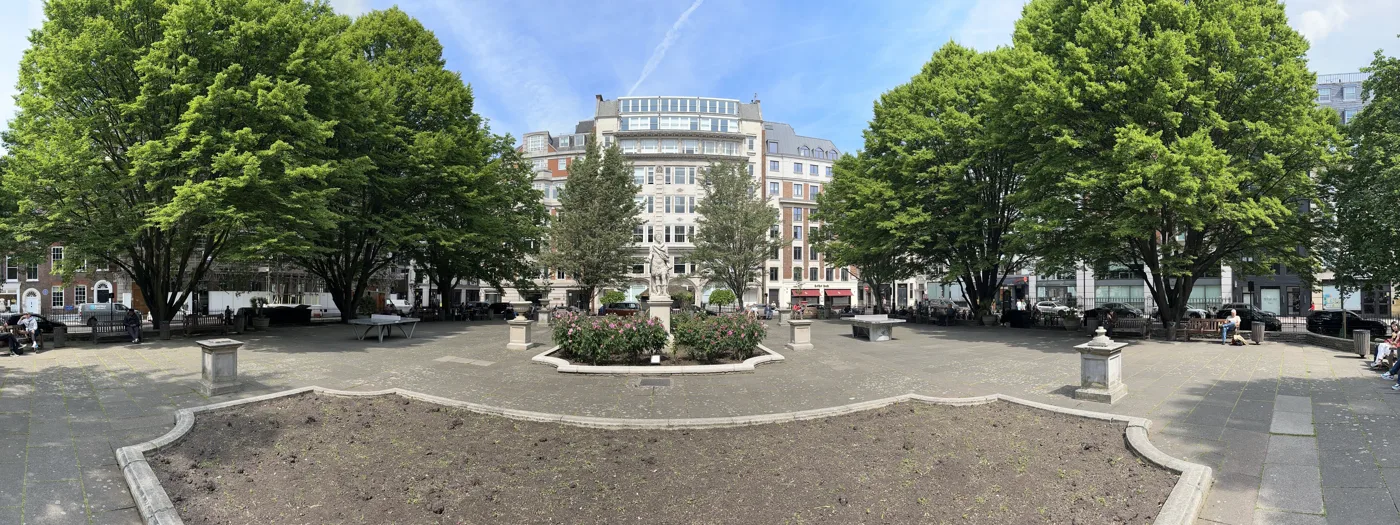

Westminster decides on 28 September whether 16 Golden Square gets a green plaque for Angelica Kauffman. Seven sponsors pay the £3,500 fee, not the council.
Westminster City Council decides on Monday 28 September whether to put a commemorative green plaque on 16 Golden Square in Soho. It would mark the house where the painter Angelica Kauffman lived and worked for 14 years, and where she was living when she became one of the two women who founded the Royal Academy.
The proposal was published on the council’s decisions register on 18 September. It goes to the Cabinet Member for Resident Services and Civic Pride, Cllr Robert Rigby. It is not a key decision and it is not subject to call-in, so if he signs it, that is the end of the process.
The wording the council has drawn up reads:
- Angelica Kauffman RA
- 1741 Chur to 1807 Rome
- Artist, Founding Member of the Royal Academy
- Lived & worked here 1767-81
Who she was
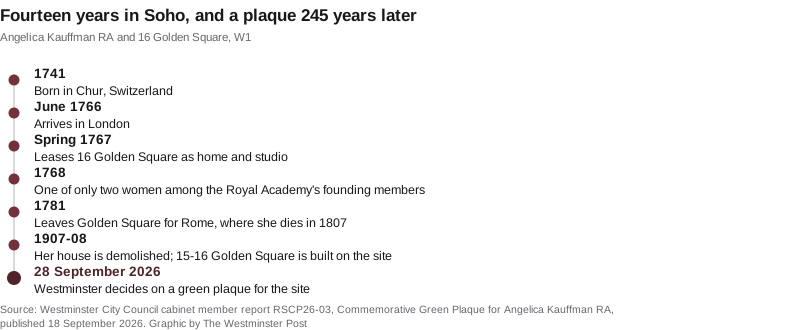
Kauffman was born in Chur in Switzerland in 1741 and arrived in London in June 1766. By the spring of 1767 she was earning enough to lease a house on Golden Square, then the fashionable quarter for artists. The council’s report records that the house was one of the larger ones on the south side of the square, with tall front windows facing north for the best light, so the front rooms were most likely her studio and showroom.
In 1768, less than two years after she arrived, she became one of only two women among the Royal Academy’s founding members. The other was Mary Moser.
That status came with limits. Cathie Pilkington RA, the Keeper of the Royal Academy, sets them out in her statement of support for the plaque. In Johan Zoffany’s painting of the Academicians in 1772, the artists are gathered round a nude model in the life room at Somerset House. Kauffman and Moser are in the picture only as two portraits hanging on the wall, because Academy law did not allow women into the life room. “It took another 168 years and a suffragette occupation before the first woman was elected,” she writes.
Kauffman stayed at Golden Square until 1781, when she moved to Rome. She carried on exhibiting at the Royal Academy from there. When she died in 1807 the sculptor Antonio Canova organised her funeral, and a bust of her was placed in the Pantheon beside that of Raphael.
Rebecca Salter, the President of the Royal Academy, also backs the nomination. “Her presence at the establishment of this great institution remains an inspiration,” she writes.
The house is gone, and the number on the door is wrong
The building Kauffman lived in no longer exists. It was demolished in 1907-08 and 15-16 Golden Square was put up in its place.
There is a further wrinkle, and the council’s report deals with it head on. The building shows the number 15 from the street. The freeholder, Universities Superannuation Scheme Limited, has confirmed that the building is 15 to 16 Golden Square, and that number 15 now covers a plot that was historically two separate plots. USS has given written permission for the plaque, which the scheme cannot proceed without.
The site sits in the West End ward. The report says the placement complements the plaque in nearby Leicester Square to her friend Sir Joshua Reynolds.
The council is not paying for it
Westminster’s green plaque scheme runs on sponsorship. The council’s own green plaques page tells anyone making a nomination to have sponsorship of £3,500 plus VAT in place before they submit it.
For this plaque the report records that fee being charged to seven sponsors who are covering the cost between them, with the Royal Academy of Arts credited as the sponsor on the plaque itself. The report’s financial summary says the plaque comes “at no cost to the Council”.
The nomination was put together by Clare Lynch, a Soho resident and local historian, named in the report as project lead and nominator. The council does pick up one long-term cost: it will be responsible for any future repair or replacement, though the report says it holds a small reserve for that and expects little to be needed.
The plaque itself would be cast by Leander Architectural from 100% recycled metal and installed by FM Conway.
How a green plaque gets approved
The scheme started in 1991. The council’s published list of plaques now runs to 140, the most recent installed in December 2025 at 22 Lancaster Gate, the former headquarters of the Football Association.
Nominations are judged by an independent advisory panel before any decision is made. The panel for this one was made up of Rachel Anthony of the City of Westminster Guide Lecturers Association, Helen Glew, senior lecturer in history at the University of Westminster, Gillian Staples, the council’s archives, collections and resources lead, and Colin Thom, senior research associate on the Survey of London at UCL. The ward councillor, Cllr Tim Barnes, also supports it.
To qualify, the council says a person must:
- be regarded as eminent by most members of their profession
- deserve recognition for a genuine contribution to society or for improving lives
- be reasonably well known
- have a strong connection to Westminster and to the nominated building
- have lived long enough ago for a lasting contribution to be clear
Anniversaries and short stays by public figures are not enough on their own. Shops, restaurants and organisations have to have existed for at least 100 years.
What it means for you
If you want to put a plaque on a Westminster building, three things decide whether it is realistic. You need the building owner’s written permission, which the council treats as non-negotiable. You need the £3,500 plus VAT sponsorship in place before you apply, which is why plaques tend to be backed by institutions or by groups of sponsors rather than by one person. And you need to time it: the panel meets only twice a year, in January and in July or August, so a nomination submitted in September waits months for its first hearing.
Nominations go in through the council’s green plaque nomination form, and the team can be reached at greenplaques@westminster.gov.uk.
No installation or unveiling date has been published for this plaque. The decision is due on 28 September, and we will report it when it is signed.
More Westminster coverage: planning news and things to do in Westminster.
Have your say