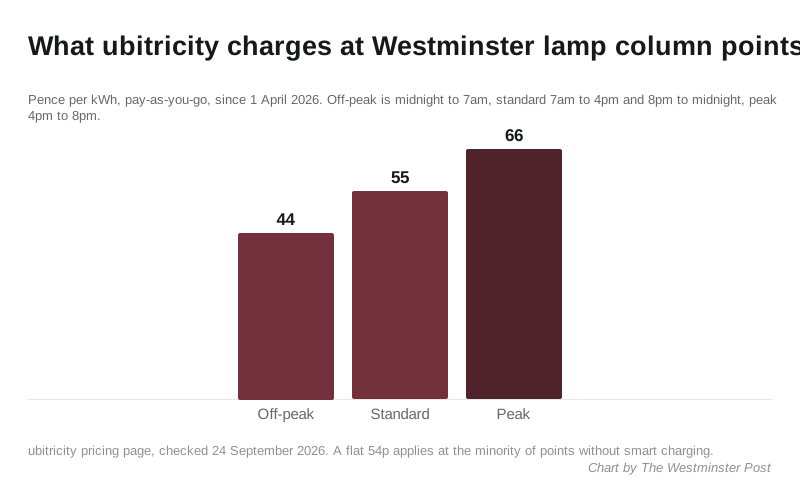

Westminster has over 2,500 on-street EV charge points. Ubitricity's April 2026 rates run 44p to 66p a kWh, and idle fees start after an hour.
Westminster EV charging is the largest lamp column operation in the country, and the thing residents most often get wrong about it is who sets the price. The council owns the lamp posts and decides where the points go. It does not set what you pay. That comes from whichever operator runs the point you have plugged into, and on the residential lamp column network that means ubitricity, whose tariff changed on 1 April 2026.
The council’s electric vehicles page, last updated on 16 September 2026, puts the network at more than 2,500 on-street charge points, ranging from 5kW to 50kW, with more being added.
Where the points are, and what they charge at
The network is not one thing. It is three, and they behave differently.
Lamp column points. The bulk of it. Units fitted inside or next to lamp columns alongside resident parking bays, aimed at residents charging overnight. These are the slow ones, 5kW upward. The council has also created more than 400 dedicated EV charging bays alongside lamp column points, so residents are not competing with general parking for access to them. The council asks, reasonably, that you unplug and move once you have enough charge.
Free-standing fast points. These have dedicated EV bays next to them, and the rule is specific: you can charge for up to four hours, between 8.30am and 6.30pm, every day. These are open to all EV drivers, not just residents. Note the window matches Westminster’s general parking control hours, which end at 6.30pm.
Rapid chargers. There are 31 DC rapid chargers at 50kW on the council’s road network, reachable by app or contactless.
One useful detail on payment: every charge point rated 22kW and above has a contactless payment terminal. Below that, on the lamp column units, you are into an app or a QR code or an RFID card from the operator. If you do not know who operates a given point, Zap Map will tell you before you get there.
Who runs them
The council names three operators on the network: TotalEnergies, ESB and ubitricity. Its separate faulty charge point page, updated 19 March 2026, adds BP Pulse and Source London as operators of fast points, and confirms ubitricity as the supplier of the residential lamp column points.
That page is also the one to bookmark, because it carries the fault numbers:
- ubitricity (lamp columns): 0800 024 6279, support@ubitricity.co.uk
- BP Pulse: 0330 016 5126
- Source London: 0203 056 89 89
- ESB: 03456090372
Report faults to the operator whose details are on the post, or through the council’s Report It service. Do not use a point showing any sign of damage.
The tariff, dated
The council does not publish charging prices. It says only that there are fees to connect, and that they differ between operators and between pay-as-you-go and monthly schemes. So the numbers below come from the operator.
Ubitricity’s rates, in force since 1 April 2026 and applying to its lamp post and bollard points in Westminster:
| Band | Hours | Rate |
|---|---|---|
| Off-peak | Midnight to 7am | 44p per kWh |
| Standard | 7am to 4pm, 8pm to midnight | 55p per kWh |
| Peak | 4pm to 8pm | 66p per kWh |
Where smart charging is not available, a small minority of points run a flat rate of 54p per kWh instead. The April 2026 change replaced separate summer and winter tariffs with one year-round structure.
Two things worth knowing that are easy to miss:
- There is no connection or subscription fee. Ubitricity dropped connection fees on 8 April 2024, and the kWh price shown when you scan the QR code is the whole cost.
- Smart charging skips the peak band. Plug in at any hour and select smart charging, and the session automatically pauses over the 4pm to 8pm window and resumes at 8pm, so you pay standard rather than peak. It is not available on ubitricity’s 7 to 22kW points.
Charging through the Shell app rather than pay-as-you-go starts from 38p per kWh, and a Shell Recharge subscription is advertised at 30% off across the Shell Recharge network. Rates can vary point to point, so check the price in the app before you start.
Prices verified against ubitricity’s own pricing page on 24 September 2026.
The overstay charge people get caught by
This is the fee nobody reads about until it appears on a statement.
Ubitricity applies an idle fee of 5p per minute on its 7 to 22kW charge points, beginning 60 minutes after your charge has completed, and only between 8am and 8pm. It applies to drivers paying through the pay-as-you-go page or directly at the charge point. The logic is the council’s own request in harder form: the bay is there so the next resident can charge, not so you can park.
The practical reading for a Westminster resident: an overnight charge on a lamp column point, finished at 3am and unplugged at 8.30am, costs you nothing extra, because the clock only runs from 8am and you have an hour of grace. A car left plugged in all day after a morning top-up on a 22kW point is a different matter.
Parking is a separate bill, and it got dearer in 2024
The most common misunderstanding about Westminster EV charging is that plugging in sorts out the parking. Mostly it does not.
The council withdrew two concessions in 2024. The arrangement that let EV and PHEV drivers park in pay-to-park bays for the maximum stay on a 10-minute payment was scrapped, so electric and plug-in hybrid drivers now pay for the full duration of the stay like everyone else. Free resident permits for EVs and PHEVs also ceased.
What survives:
- Discounted parking for electric vehicles, on both pay-to-park and resident permits.
- Free parking while you charge in the dedicated EV bays alongside on-street charging points.
- No ULEZ charge.
- A Congestion Charge discount: since 2 January 2026, TfL’s Cleaner Vehicle Discount gives 25% off for electric cars and 50% off for electric vans, HGVs and quadricycles, applied automatically if the vehicle is registered for Auto Pay. Those rates drop to 12.5% and 25% on 4 March 2030.
So the honest sum for a Westminster resident with an EV is: a discounted permit, a per-kWh price set by the operator, a possible idle fee, and full price in a pay-to-park bay. Our parking zones and hours page covers where you are allowed to leave it.
How to request a charge point on your street
The council runs an online form for this, and it is worth setting expectations before you fill it in.
It asks for your address and postcode, your preferred location for the point, whether you already have an EV or plug-in hybrid and its make, model and registration, whether you have one on order and when it arrives, whether you have off-street parking, and which type of facility you would prefer: a point on an existing lamp column beside a resident bay, or a charging post beside a dedicated EV-only bay.
What happens next is the part to be clear-eyed about. The council states plainly that it cannot guarantee a point, that requests are considered collectively to assess demand and plan future installation programmes, and that because of the volume of interest it will not respond to requests individually. Some lamp columns cannot be converted at all, and others sit in unusable positions.
In other words it is a demand signal, not an application. If several neighbours want a point on the same street, several of you filling in the form is the thing that registers.
Two things not to do
Do not run a cable across the pavement. The council says explicitly that it does not support charging from a domestic or business supply over the public highway, because of the risk to people walking past. It also advises against extension leads, which can overheat under a sustained charging load.
Do not count on the car club. Zipcar, the council’s appointed car club operator, has withdrawn from car sharing in the UK. The council says it is talking to remaining operators about replacement services, so anyone who was using a club car as the reason not to own one should check the position before relying on it.
For the rest of getting about the borough, see our roadworks and travel page and the Blue Badge guide.
Frequently asked questions
How many EV charge points are there in Westminster? More than 2,500 on-street points, ranging from 5kW to 50kW, according to the council’s own figure as of 16 September 2026. That includes lamp column units, free-standing fast chargers and 31 DC rapid chargers at 50kW.
How much does it cost to charge an electric car in Westminster? On ubitricity’s lamp column network, and since 1 April 2026: 44p per kWh off-peak between midnight and 7am, 55p standard between 7am and 4pm and 8pm and midnight, and 66p peak between 4pm and 8pm. A small number of points without smart charging run a flat 54p. There is no connection or subscription fee. Other operators set their own prices.
Is there an overstay fee at Westminster charge points? Ubitricity charges an idle fee of 5p a minute on its 7 to 22kW points, starting an hour after your charge completes, and only between 8am and 8pm. Below 7kW there is no idle fee. The council separately asks drivers to unplug and move on once charged.
Do I still need to pay for parking if my car is electric? Yes, in pay-to-park bays. Westminster withdrew the concession that let EVs and PHEVs pay for 10 minutes and stay for the maximum period, so you pay for the full duration. It also stopped issuing free resident permits for EVs and PHEVs. Parking is free while you are actually charging in a dedicated EV bay alongside an on-street point.
Who do I call about a broken charge point? The operator named on the post, or the council’s Report It service. Ubitricity is on 0800 024 6279, BP Pulse on 0330 016 5126, Source London on 0203 056 89 89 and ESB on 03456090372.
Can I ask for a charge point on my street? Yes, through the council’s online request form, but treat it as a demand signal rather than an application. The council collates requests to plan future installations, cannot guarantee a point, and says it will not reply to requests individually. Some lamp columns cannot host a charge point at all.
Can I charge from my house using a cable across the pavement? No. The council does not support running a cable from a domestic or business supply across the public highway because of the risk to pedestrians, and advises against extension leads, which can overheat under continuous charging load.
Have your say