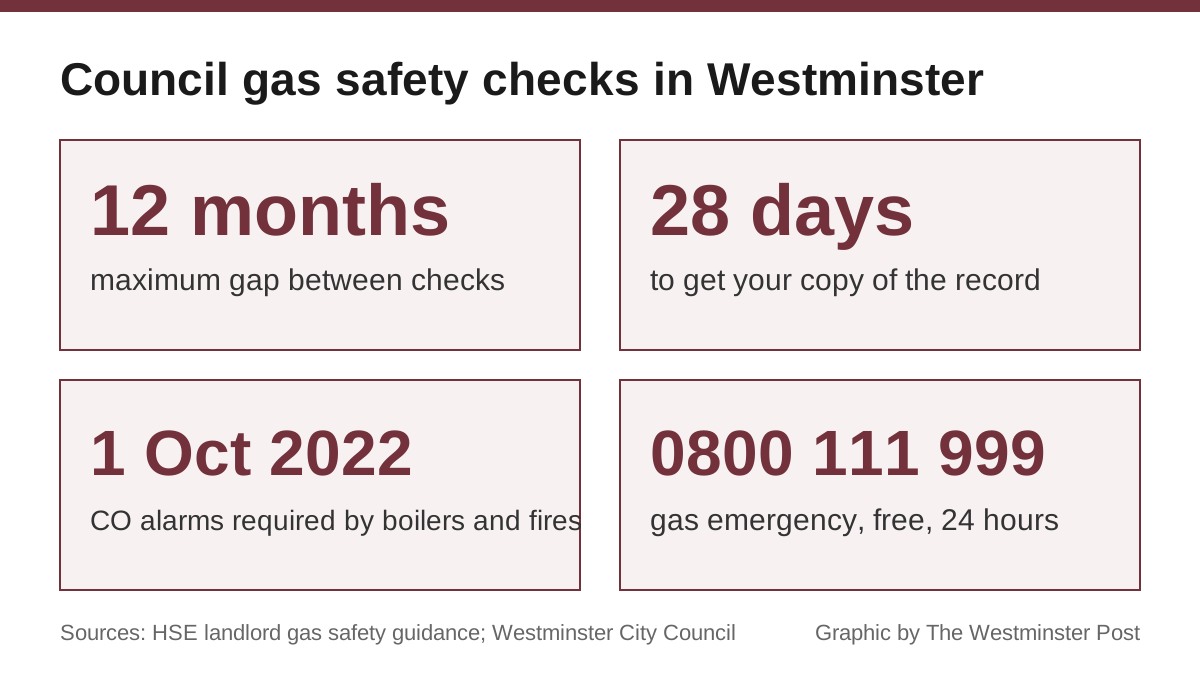

Westminster's council gas safety check is yearly and a tenancy condition: refuse access and the council can seek an injunction. CO alarms, leaseholders.
Westminster City Council’s gas safety check is a yearly inspection of every gas appliance the council has fitted in a tenant’s home, and letting the engineer in is a condition of your tenancy. The council’s tenant handbook says it “will take legal action against tenants who do not let us in”, and its repairs policy names the route: an access injunction from the county court. The check is free, the engineer must leave a copy of the certificate, and the law gives you that copy within 28 days.
This page sets out how the Westminster gas safety check is booked, what happens if you miss it, the carbon monoxide alarm rules for council homes, and where leaseholders stand. It draws on the council’s gas safety page (last updated 19 August 2026), the tenant handbook and the housing repairs policy, all read on 22 October 2026.
What the council checks, and how often
Where the council has fitted a gas boiler, gas fire or gas hot water system, its contractors service and inspect each appliance every year and give you a copy of the gas check certificate. Westminster’s repairs charter lists gas servicing as annual; electrical checks are separate, at ten years after a home is built and every five years after that.
The yearly check is not the council being cautious. Under the Gas Safety (Installation and Use) Regulations 1998, every landlord, the council included, must have the gas appliances and flues it provides checked by a Gas Safe registered engineer at least every 12 months. The Health and Safety Executive’s guidance for landlords sets out the rest of the rules that matter to tenants:
- The check can be done from 10 months after the last one without changing the anniversary date, so an early appointment does not mean a shorter year.
- Existing tenants must be given a copy of the record within 28 days of the check. New tenants must get one before they move in.
- The landlord must keep records for at least two years.
The check covers what the council provides. A gas cooker you bought yourself is your own appliance, so ask the engineer to look at it while they are there rather than assume it has been checked.
How the appointment is booked
The council writes to tell you when the inspection is due and its contractor arranges an appointment. A responsible adult aged 18 or over must be at home to let the engineer in; the council’s repairs charter says the same applies to all repairs and compliance checks. Engineers should carry identification; ask to see it before you let anyone in.
If the date does not work, contact the council’s housing line on 0800 358 3783 to change it rather than simply not answering the door. The council says it will “make every effort to reschedule” and that it documents every attempt to get in, which matters later if the case reaches court.
What happens if you do not let the engineer in
The council is legally required to do the check, so it treats repeated no-access as a tenancy breach rather than a missed appointment. In practice that runs in stages:
- Rearranged appointments and letters. Several attempts, each recorded.
- Legal action. The repairs policy says that where attempts to get access have failed, the council “will pursue formal routes, including access injunctions and enforcing the tenancy agreement where necessary”. An injunction is a court order requiring you to let the engineer in by a set date.
- Costs. A tenant who ignores the process can be asked to pay the council’s legal costs, and breaching an injunction is contempt of court.
None of this happens because of one missed appointment. It happens to tenants who do not respond at all. If you have a reason you cannot be in, such as hospital, work shifts or caring, tell the council, because a documented reason looks very different in the file from silence.
Carbon monoxide alarms in council homes
Since 1 October 2022, social landlords in England, including Westminster City Council, must fit a carbon monoxide alarm in any room used as living accommodation that has a fixed combustion appliance, such as a gas boiler or gas fire. Gas cookers are excluded. The landlord must also repair or replace an alarm once told it is faulty.
So if your boiler or gas fire is in a room without a CO alarm, report it as a repair. Test it the same way you test the smoke alarm, which the council asks tenants to do weekly. The handbook also asks you to keep air vents clear and to switch off gas fires in rooms where people are sleeping.
Carbon monoxide has no smell. Headaches, dizziness, nausea and tiredness that ease when you leave the house are the classic warning signs. If you suspect it, turn the appliance off, open the windows, leave and call the gas emergency number below.
If you smell gas
Call the free 24-hour national gas emergency number, 0800 111 999, whether the smell is inside or outside your home. While you wait:
- open doors and windows;
- turn the gas off at the meter, unless the meter is in a cellar or basement;
- do not use light switches, doorbells or a naked flame;
- do not smoke.
Report a broken boiler or a loss of gas supply to the council as a repair. Westminster’s repairs policy classes total or partial loss of gas, a blocked flue, and no heating or hot water between 1 November and 30 April as top-priority jobs. Our Westminster council repairs page sets out the deadlines.
Leaseholders: your appliances are your responsibility
The council’s yearly check is for its tenants. If you own a leasehold flat in a council block, the boiler, fire and cooker inside your flat belong to you, and so does keeping them safe. A yearly service by a Gas Safe registered engineer is the sensible minimum. You can check an engineer is registered on the Gas Safe Register.
If you let your flat out, you are the landlord in law and the full landlord duties apply to you: a check every 12 months, a copy of the record for your tenant within 28 days, and carbon monoxide alarms in rooms with a fixed combustion appliance. The council will not do these for you.
The council’s role for leaseholders is the building and its communal parts. Work there is normally recharged through your service charge, and repairs inside the flat that the council does carry out are listed on our Westminster council repairs page.
Frequently asked questions
How often does Westminster Council do a gas safety check? Every year, for each gas appliance the council has fitted in a tenant’s home. The law allows the check to be done from 10 months after the last one without moving the anniversary date.
Do I have to let the council in for a gas safety check? Yes. Allowing access is a condition of your tenancy, and the council is legally required to do the check. If you repeatedly refuse, the council says it will take legal action, including applying for an access injunction.
Can I rearrange my gas safety appointment? Yes. Call the council’s housing line on 0800 358 3783. Rearranging is far better than not answering the door, because every failed attempt is recorded.
Do I get a copy of the gas safety certificate? Yes. The council gives tenants a copy of the gas check certificate, and the law says existing tenants must receive it within 28 days of the check.
Does the council check my gas cooker? The yearly check covers the gas appliances the council provides. If you own your cooker, ask the engineer about it at the visit. Gas cookers are also the one combustion appliance not covered by the carbon monoxide alarm rule.
Does the council do gas safety checks for leaseholders? No. Leaseholders are responsible for the gas appliances inside their own flats. If you let your flat, you must arrange the yearly landlord gas safety check yourself.
Have your say