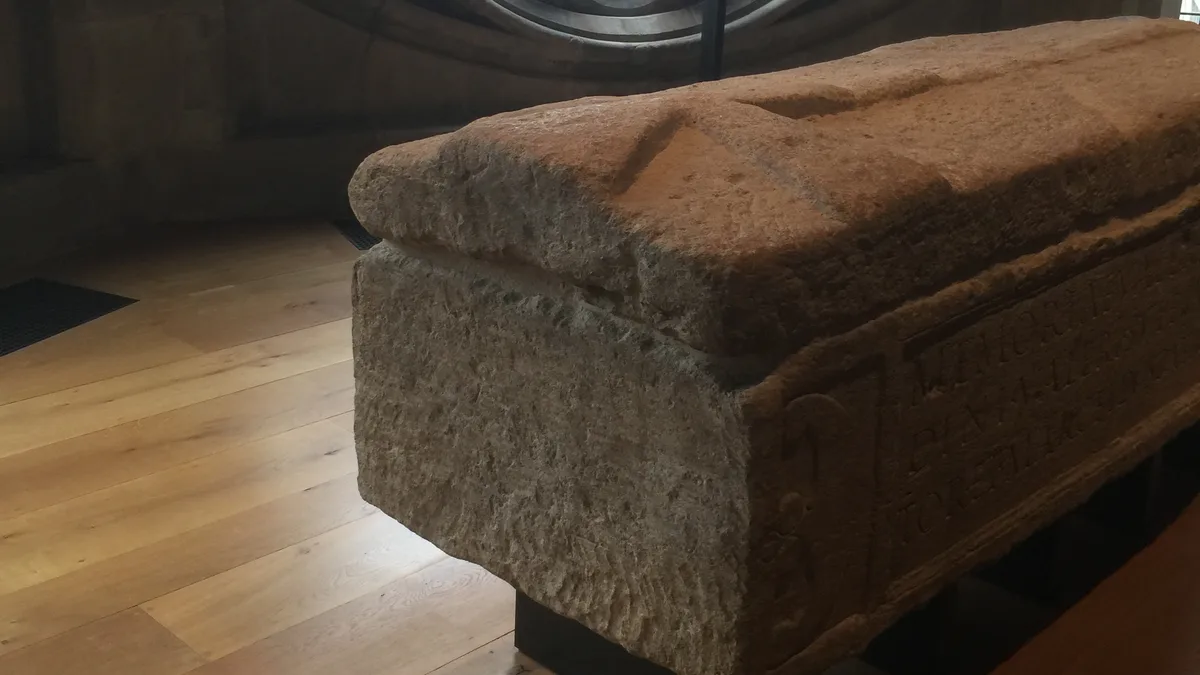

Carbon dating puts the bones at 987 to 1052 AD. The Abbey's archaeologist names Abbot Aelfwig, who died around 1020, as the likely occupant. The coffin is on show.
The skeleton found inside a Roman stone coffin at Westminster Abbey in 1869 was probably a Saxon abbot. That is the conclusion of new research by the Abbey’s Consultant Archaeologist, Professor Warwick Rodwell. The Abbey announced it on Wednesday.
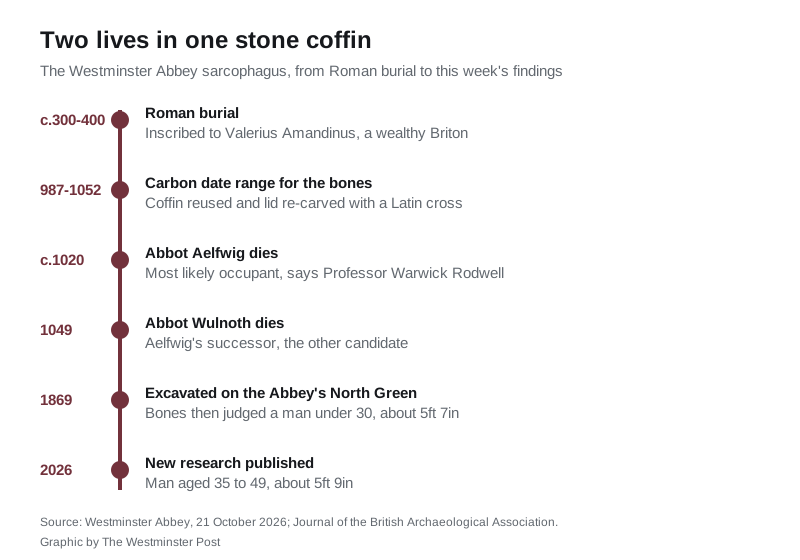
His most likely candidate is Aelfwig, Abbot of the Benedictine monastery at Westminster, who died in around 1020. The other is Aelfwig’s successor, Wulnoth, who died in 1049. Both are presumed to have been buried at the Abbey.
The full study, “Westminster Abbey’s Roman Sarcophagus and its Afterlife”, runs to 35 pages in the Journal of the British Archaeological Association. It was published online on 20 October.
The quick answer
- What: a limestone Roman sarcophagus dug up on the Abbey’s North Green in 1869.
- First owner: Valerius Amandinus, a wealthy Briton of around 300 to 400 AD, named in its inscription.
- Second occupant: a man aged 35 to 49, about 5ft 9in tall, carbon dated to 987 to 1052 AD.
- Who he probably was: Abbot Aelfwig (died around 1020), or possibly Abbot Wulnoth (died 1049).
- Where to see it: on permanent display in the Queen’s Diamond Jubilee Galleries, inside the Abbey.
Why it was a puzzle for 157 years
The coffin’s inscription names Valerius Amandinus, who lived in the Roman city in around 300 to 400 AD. But the lid also carries a Latin cross, carved in the 10th or 11th century.
That cross meant the coffin had been opened and reused centuries after the Roman burial. The bones found inside belonged to that later person. Who he was has never been settled.
What the new tests found
The research brought in several specialists, according to the Abbey. Their main findings were:
- Age and height. Human bone specialist James Young Langthorne, of Pre-Construct Archaeology, put the man’s age at between 35 and 49. He was around 5ft 9in tall.
- A correction to the Victorians. An assessment in the 1800s had described a “robust young man” of around 5ft 7in, aged no more than 30.
- The date. A bone sample went to the Scottish Universities Environmental Research Centre for carbon dating. It returned 987 to 1052 AD.
The Abbey says the carbon date confirms the coffin was reused, and its lid remodelled, in the late Saxon period.
Why an abbot
The clue is the burial itself. The man’s wooden coffin was placed inside the stone sarcophagus, and the lid was re-carved with a large Latin cross. The Abbey says he was “honoured” with burial in a “fine sarcophagus”, which points to someone of high rank in the monastery.
Professor Rodwell said: “We have two viable contenders for the occupant of the sarcophagus. We do not know the date of birth of either. But either would fit equally well if we assume the Abbot was in his early twenties when the appointment was made and close to fifty when he died. The fact Aelfwig was already a monk of Westminster might favour him.”
The finding is a judgement on the evidence, not a certainty. The Abbey itself says the identity “appears closer to being solved”.
What it means for you
You can see the sarcophagus yourself. It is on permanent display in the Queen’s Diamond Jubilee Galleries, high in the Abbey’s 13th-century triforium. Look for the cross on the lid and the Roman lettering on the side.
Before you go:
- Two tickets. You need a standard Abbey sightseeing ticket plus a separate timed entry ticket for the Galleries.
- Abbey entry prices. Adults pay £32, over-65s and students £29, children aged 6 to 17 £14. Under-6s go free.
- Universal Credit. Adults receiving Universal Credit pay £1, as does a family of one adult and one child.
- Disabled visitors. Registered disabled visitors get free admission to the Galleries.
- Getting up. Entry is through the Weston Tower, next to Poets’ Corner. A lift gives step-free access.
- Sundays. The Galleries are closed on Sundays.
The Abbey’s two visitor pages give slightly different Galleries opening hours, so check the times on the day you book.
For more on the Abbey’s plans, read our report on the Tolkien memorial coming to Poets’ Corner. For other days out, see things to do in Westminster.
Have your say